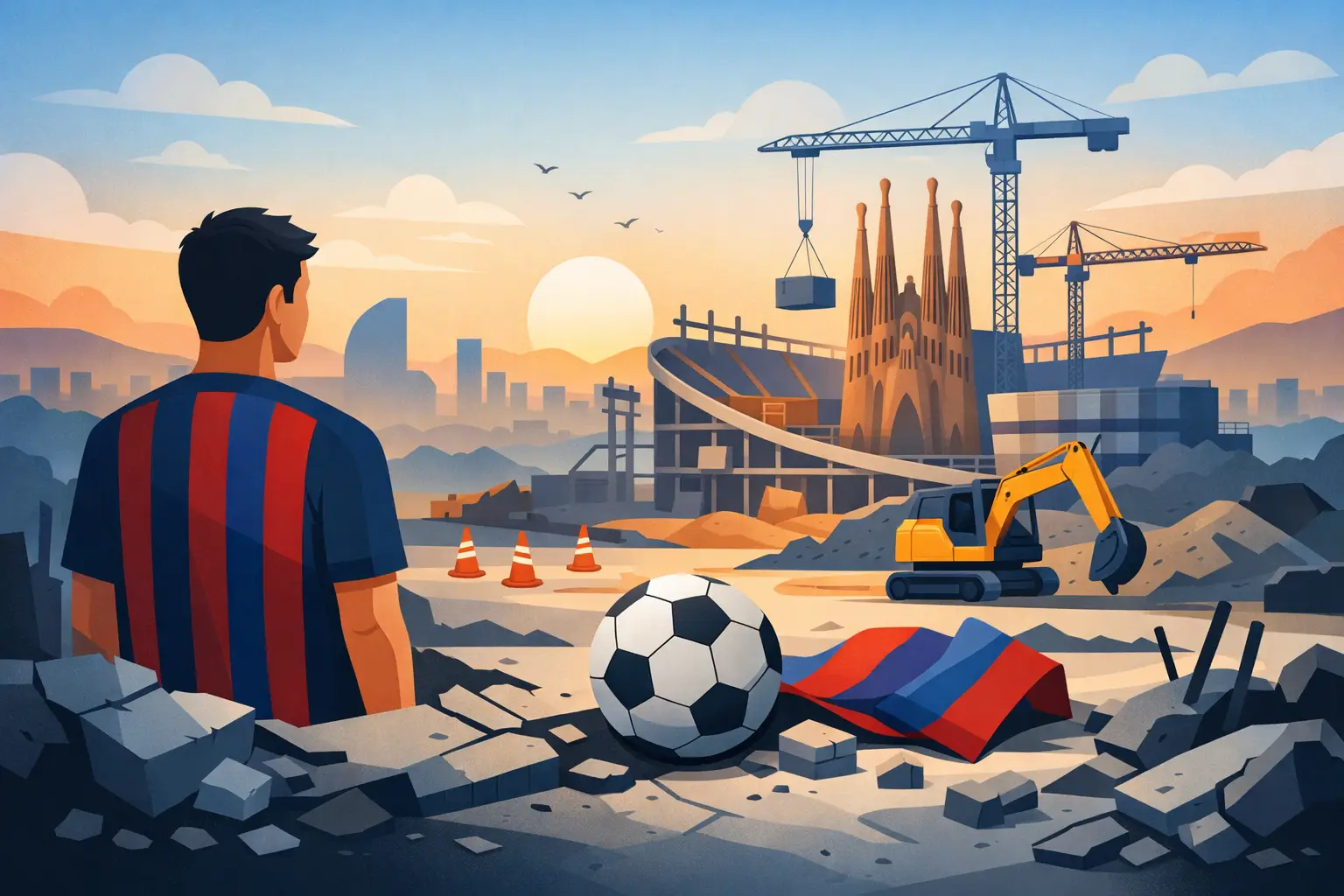
The Barcelona rebuild has reached the stage that tests every big club: the excitement of change has faded, while the demands have only grown. Barça cannot simply point to a promising teenager, a big summer signing, or a good run of form and call the job finished. The next version of this team has to survive a full season, compete with Europe’s elite, and still look unmistakably like Barcelona while doing it.
That is the challenge. The rebuild is not just about replacing old names with younger ones. It is about restoring a sporting model after years in which financial pressure, hurried squad planning, and short-term needs often pulled the club in different directions.
The Barcelona rebuild is about more than transfers
Transfer windows make the biggest noise, especially around Barcelona. Every rumor can feel like a statement of intent, and every missed operation is treated as a crisis. But the club’s most important work is less dramatic: deciding which players form the long-term spine, which roles need outside help, and which academy talents must be protected from being rushed or blocked.
A rebuild becomes fragile when recruitment is based on names rather than functions. Barça have learned that lesson the hard way. A famous attacker might lift the mood, but he does not automatically solve a lack of control in midfield, defensive recovery in transition, or depth across a brutal league and Champions League calendar.
The strongest Barcelona sides have always had a clear internal logic. The goalkeeper starts attacks. The center-backs defend large spaces and play through pressure. Midfielders dictate rhythm. Wide players stretch the field or create one-on-one danger. The striker gives the entire structure a reference point. When those pieces complement one another, the shirt carries real weight. When they do not, even talented squads can look disconnected.
That means the right signing is sometimes the less glamorous one: a defender who can defend high, a midfielder who can receive under pressure, or a forward who presses with intelligence rather than simply adding goals. For a club working within financial limits, that distinction is everything.
La Masia cannot be the emergency plan
La Masia remains the emotional center of the Barcelona rebuild, and rightly so. The academy has repeatedly supplied players who understand the club’s football before they ever enter the first-team dressing room. They know what it means to ask for the ball in tight areas, to play with responsibility, and to carry the expectations that come with the badge.
Lamine Yamal, Pau Cubarsí, Alejandro Balde, Gavi, Pedri, and Fermín López have all represented, in different ways, the value of trusting young talent. Their presence has given supporters something more meaningful than a temporary surge of optimism. It has given the project a recognizable face.
Still, relying on youth is not the same as building around youth. That is a crucial difference. Young players need physical management, clear roles, experienced teammates, and room to make mistakes without becoming the target after every poor result. A teenager can win a match. He should not have to rescue an entire institution every three days.
Barcelona must be disciplined here. If a La Masia player is good enough, the pathway should be real. But first-team opportunities cannot become a substitute for squad depth or strategic planning. The best environment for academy players is not chaos. It is a stable team in which they can contribute without carrying the whole burden.
Protecting the core matters as much as finding it
The temptation around a young star is always to demand more: more minutes, more goals, more leadership, more commercial value. Barça have to resist that cycle. The club’s future will be shaped not only by who breaks through, but by how carefully those players are developed once the spotlight is on them.
There is also a footballing issue. A team built around technically gifted youngsters still requires leaders who have already navigated title races, hostile away nights, and Champions League knockout ties. Experience is not a sentimental luxury. It is often the difference between controlling a difficult moment and chasing one.
Financial discipline must become a sporting advantage
For years, Barcelona’s financial reality has dominated conversations around registrations, departures, contract structures, and transfer operations. Supporters understandably want clarity and ambition, but the rebuild will only be sustainable if the club stops treating every summer as a rescue mission.
That does not mean accepting mediocrity. It means making each decision serve the plan. A reduced wage bill, smarter contract timing, and more selective spending can give the sporting department room to act when the right player becomes available. The alternative is familiar: chasing opportunity deals, negotiating under pressure, and building a squad with too many overlapping profiles.
Selling well matters too. Not every departure is a betrayal of Barça identity. Sometimes a player needs a clearer path elsewhere, and sometimes the club needs to make a difficult decision before value disappears. The key is to distinguish between selling a useful asset and weakening a position that will cost far more to replace.
A healthy rebuild has fewer panic moves. It has a clear salary structure, a realistic succession plan, and the confidence to say no when an operation makes little sporting sense. That may not generate the loudest headlines, but it is how elite teams remain competitive beyond one promising season.
The coach needs a team, not just a starting XI
The coach is judged by results, as he should be at Barcelona. But no tactical idea can fully flourish if the squad only works in its strongest eleven. A title challenge is decided in the weeks when injuries pile up, form drops, and rotation becomes unavoidable.
Barça need enough depth to preserve their style without becoming predictable. That includes options in midfield, reliable cover in defense, and attacking alternatives with distinct qualities. One substitute may be useful for protecting a lead; another may be needed to break down a deep block. A squad built with only one solution will eventually meet an opponent that exposes it.
The tactical balance is equally important. Barcelona supporters want proactive football, possession with purpose, and courage in big moments. But possession alone is not control. The team must be able to defend transitions, win duels when games become physical, and manage matches when the ideal passing lane is unavailable.
That is where the rebuild becomes truly mature. It is not about abandoning Barça principles for pragmatism. It is about giving those principles enough defensive and physical support to work against the best sides in Europe.
Patience has to coexist with standards
Patience is often demanded from supporters as if it means lowering expectations. At Barcelona, that is never going to be realistic, nor should it be. This club exists to fight for LaLiga, compete seriously in Europe, and produce football that supporters recognize as their own.
But standards should be measured with context. A young core will have uneven stretches. New signings can need time. Financial constraints may force difficult choices. Not every setback proves the project is broken, just as every win does not prove it is complete.
The real question is whether the direction remains clear. Are the best young players improving? Is the squad becoming more balanced? Are recruitment decisions tied to a recognizable style? Is the club becoming less dependent on emergency solutions? Those are the signs that matter when judging the Barcelona rebuild.
For Barça supporters, the next step is not to wait for a single savior or one perfect transfer window. It is to demand a team that grows stronger without losing its memory: brave on the ball, ruthless when the moment arrives, and built to make the future feel like Barcelona again.

Discover more from Barça Buzz
Subscribe to get the latest posts sent to your email.