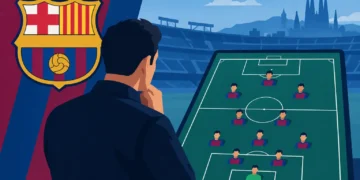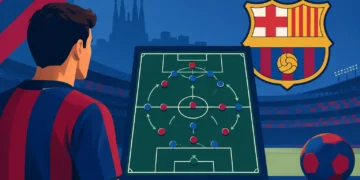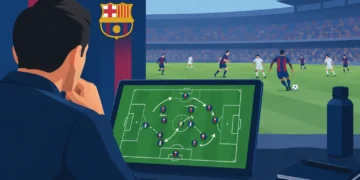

A Barcelona result can tell one story. The spaces between the lines tell another. Barcelona match analysis today should start there, not with possession totals or a single missed chance. Barça can dominate the ball and still look vulnerable, while a tighter, less glamorous win can reveal a team that is growing in control when the game becomes uncomfortable.
For supporters, the real question after the final whistle is simple: did Barça impose its football, or did it merely survive the match? That distinction matters in a season where every league point, every European night, and every minute handed to a young player can shape the club’s direction.
Barcelona match analysis today starts with control
Control is not simply having 65 percent of the ball. At Barcelona, it means knowing where the next pass is going before pressure arrives. It means the center backs can progress possession without forcing the pivot to receive with his back to goal under pressure. It means the attackers are positioned to stretch the opposition rather than standing in the same lane.
When Barça are at their best, the ball moves from defense into midfield with purpose. One midfielder drops or turns to create a passing angle, another occupies the next line, and the wide players pin back the opposing fullbacks. The objective is not pretty circulation for its own sake. It is to create the moment when an opponent has to step out, leaving a gap behind him.
Watch how often Barça reach the final third through the center compared with how often they are pushed toward harmless crosses. A team can have plenty of touches near the penalty area without truly threatening. If the ball repeatedly goes wide because the middle is blocked, Barça need better movement between the lines, not just more attacking players in the box.
The first major signal, then, is whether the midfield gave the team rhythm. If the ball traveled forward, backward, and forward again with the opposition constantly adjusting, Barça likely controlled the tempo. If every forward pass felt forced, the opponent probably won the more important battle.
The middle of the pitch decides more than possession
Barça’s identity has always been tied to midfield authority. From Cruyff’s principles to the eras of Xavi and Andrés Iniesta, the club’s strongest sides made opponents chase shadows before they ever reached the penalty area. The names change, but the requirement does not: midfielders must offer security, imagination, and intensity in equal measure.
Today, pay attention to the distances between the midfield line and the front line. When those gaps become too large, Barça can lose the ball with too few players close enough to counterpress. That is when transitions become dangerous, especially against opponents with direct runners and pace in the channels.
A strong performance in the middle is often visible in small actions. A midfielder receives on the half-turn instead of playing the safe pass. A teammate immediately moves into the space he has vacated. The nearest three or four players react together when possession is lost. Those sequences do not always make highlight reels, but they decide whether Barça are building attacks or constantly putting out fires.
Buildup must create an advantage
The second key signal is whether the buildup created a numerical or positional advantage. If an opponent presses high, Barça need calm defenders and midfielders who can draw that press before playing through it. If the opponent sits deep, the challenge flips: circulation must be quicker, and players need to make runs that disturb a compact block.
There is a trade-off here. Pushing fullbacks high can add width and create overloads, but it also leaves space behind them when a move breaks down. Asking a pivot to drop between center backs can improve the first phase, yet it may remove a valuable player from the zone where Barça need to connect with the forwards. There is no automatic solution. The right choice depends on the opponent’s shape and the speed of Barça’s recovery.
The clearest sign of a healthy buildup is not the number of passes. It is the number of times Barça receive facing forward in dangerous territory. When attackers get the ball with options around them, the game begins to tilt.
The press reveals the team’s edge
The third signal is the counterpress. Barça’s best attacking moments have often begun seconds after losing the ball. Winning it back quickly keeps the opponent trapped, protects a high defensive line, and allows the attacking structure to remain in place.
But the counterpress has to be coordinated. One player charging alone is not pressure – it is an invitation for the opponent to play around him. Look for the first reaction after a turnover: who closes the ball, who blocks the nearest outlet, and who covers the pass into the channel? If those roles are clear, Barça can suffocate a game. If they are not, the defense is exposed to the kind of open-field running no possession-based side wants to face.
This is also where individual effort becomes tactical value. A forward tracking back for one extra second can stop a counter before it starts. A defender stepping forward at the right time can win the ball cleanly. Those details create the platform for the football Barça supporters expect.
Width, the penalty area, and the final pass
The fourth key signal is how Barça use the wide areas. Width is essential, but it should be a tool, not a destination. The purpose of keeping a winger high and wide is to stretch the back line, open an inside lane, or isolate a defender in a one-on-one situation.
If Barça create repeated wide overloads, the next question is whether anyone attacks the box with conviction. Too many moves can fade when the cross arrives to an empty area or when the cutback finds no runner near the penalty spot. A clinical team attacks different zones: the near post, the central area, and the far side.
This is where patience matters. Against a low block, the first opening is rarely the best one. Barça must resist forcing the final pass just because the crowd senses a chance. Yet patience cannot become predictability. A sharp combination, a third-man run, or a quick switch of play can turn sterile possession into a genuine opportunity.
Substitutions show what the match demanded
The fifth signal is the bench. Substitutions are not merely about fresh legs. They reveal how the coaching staff interpreted the game. A change in midfield may mean Barça need more control. A direct wide option may mean the opponent’s back line is tiring. A defensive adjustment can be sensible game management, but it can also show that the team has lost its ability to keep the ball.
For Barça, late-game decisions carry an added layer because La Masia pathways matter. Giving a young player meaningful minutes in a tense match is different from handing him a brief appearance after the result is settled. The former is trust. The latter may be useful experience, but it does not necessarily indicate first-team integration.
Supporters should judge young players fairly as well. One misplaced pass should not become a verdict on a prospect, particularly when he enters a chaotic match. The better questions are whether he asked for the ball, understood his defensive position, and showed the personality to repeat the right action after an error.
Read the scoreline in context
A one-goal win can be excellent if Barça limited clear chances, controlled transitions, and managed the final minutes with maturity. A three-goal victory can still leave concerns if the opposition regularly ran through midfield or if the attack depended on moments of individual brilliance.
That is why expected goals, shots, and possession are useful but incomplete. They help frame what happened, yet they cannot fully capture whether Barça were comfortable in their structure. Context matters: the opponent’s quality, fixture congestion, available personnel, injuries, and the stage of the competition all change what should be expected.
The most encouraging Barça performances usually leave a recognizable pattern. The team plays forward without becoming reckless, presses together without losing its defensive balance, and gives its most talented players the conditions to decide the game. When those elements are present, the result feels repeatable rather than accidental.
For the next match, watch the first 15 minutes closely. That is often where Barça reveal whether the lessons from today have actually traveled with them: cleaner buildup, tighter reactions after turnovers, and the courage to keep playing the football that makes this club different.

Discover more from Barça Buzz
Subscribe to get the latest posts sent to your email.