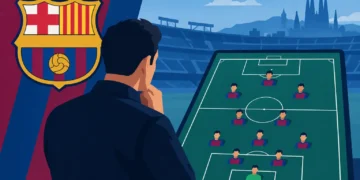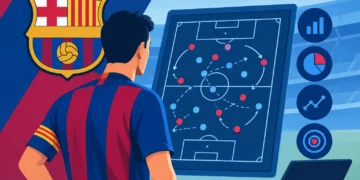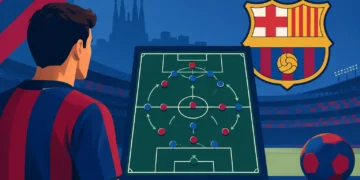
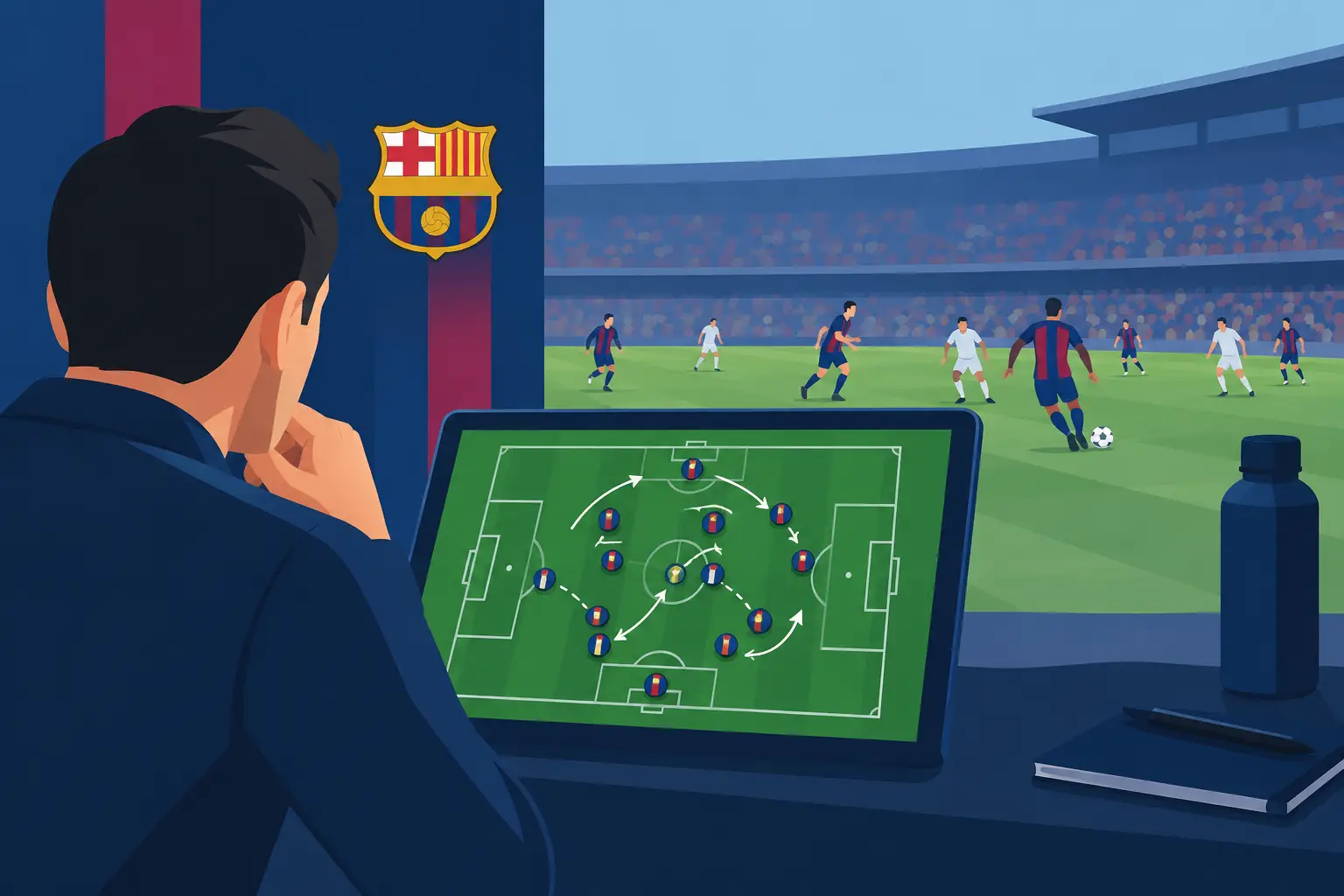
The most revealing Barcelona moment often comes before the first chance. Watch the first goal kick, the first press, and the first time a fullback moves inside. If you want to know how to read Barcelona tactics, stop following the ball for a few seconds. Look instead at who creates the free player, who protects the center, and who is being asked to make the hardest defensive run.
Barça matches can look chaotic at full speed because positions change constantly. Yet the principles underneath are familiar to anyone raised on Cruyff, Guardiola, Xavi, and the club’s La Masia tradition: control the ball, occupy the pitch intelligently, find the spare man, and react immediately when possession is lost. The shapes change with the coach, the opponent, and the personnel. The identity is usually easier to spot in the relationships between players than in a static formation graphic.
Start With Barcelona’s Shape Without the Ball
A lineup may say 4-3-3, but that only tells you where players begin. The more useful question is how Barcelona defends the opponent’s first pass. Are the wingers pressing center backs? Is the striker screening the defensive midfielder? Is one midfielder stepping high while the other stays close to the back line?
Barcelona often want to make the opponent play toward the touchline. The sideline becomes an extra defender, reducing the angles available to the ball carrier. When that trap works, a winger closes from the outside, a midfielder jumps forward, and the fullback is ready to attack the loose ball. A turnover near the opponent’s box is not luck. It is often the intended reward for a coordinated press.
Do not judge the press only by tackles. A good press can force a rushed long ball, a pass to a weak-footed defender, or a backward reset that gives Barça time to recover its own structure. If the opponent repeatedly plays through the first wave, though, that is a warning sign. The midfield may be too stretched, the front line may be arriving late, or the defensive line may be exposed behind it.
Watch the Rest Defense
The phrase “rest defense” sounds technical, but the idea is simple: when Barcelona attack, who is prepared for the counterattack?
Look at the players behind the ball when Barça have possession in the final third. There may be two center backs with a midfielder nearby, or a more conservative fullback holding position while the opposite fullback attacks. That protective structure matters because Barcelona commit numbers forward. Without it, one lost pass can leave the center backs defending a huge amount of grass.
This is where personnel changes everything. A fast center back allows a higher line. A midfielder with elite anticipation can cover more space. A fullback who attacks like a winger may give Barcelona an extra threat, but also creates a channel opponents will target in transition. Tactics are never separate from the players asked to carry them out.
How to Read Barcelona Tactics in Possession
When Barça have the ball, avoid staring at the player dribbling through midfield. Scan the width and depth of the team. Are the wingers staying wide to stretch the back four? Is the striker pinning center backs? Is a midfielder finding space between the opponent’s midfield and defense?
Barcelona’s best attacking sequences create choices the opponent does not want to make. If the opposing fullback follows the wide winger, an interior midfielder may receive in the half-space. If the center back steps out to stop that midfielder, space opens behind for a forward run. If the defense stays compact, the ball can move back out wide and restart the problem from a different angle.
That is why possession for its own sake is not the point. The point is to move the opposition until a passing lane appears. A sideways pass can be valuable if it drags a midfielder six yards out of position. A backward pass can be positive if it resets the attack and invites the opponent to press into a space Barcelona have already prepared to exploit.
The Fullbacks Tell You the Real Shape
Fullbacks are often the quickest way to understand what the coach is trying to build. When one moves into midfield, Barcelona may effectively form a box around the center, offering safer passing options against a press. When both push high, the team can overload the final third but may become vulnerable after a turnover.
An inverted fullback also changes the winger’s job. The winger may hold the touchline and attack one-on-one, or drift inside because the fullback supplies the width. Neither option is automatically better. It depends on the opponent’s defensive setup and whether Barça have the right profiles to dominate those zones.
Pay attention to the asymmetry. Barcelona rarely need both sides of the pitch to behave identically. One flank may be built for combination play through a technical midfielder and overlapping runner. The other may be designed to isolate a direct winger against a fullback. When supporters say a side is “unbalanced,” that can be a flaw, but it can also be the plan.
Find the Free Man in Midfield
At Barcelona, the midfield battle is rarely just about winning duels. It is about controlling orientation. A midfielder who receives facing forward can accelerate an entire attack. One who receives with his back to goal may need support immediately.
Watch the first touch. Does the midfielder open his body and play forward? Does he receive under pressure but retain the ball? Does he draw an opponent before releasing a teammate? These details explain why some players appear quiet on the ball while still controlling the rhythm of the match.
The classic Barça interior role demands more than passing range. It requires timing. The player must know when to drop near the pivot, when to occupy the half-space, when to arrive late in the box, and when to sprint back after possession is lost. That is also why La Masia graduates can look unusually comfortable in crowded areas. They have spent years learning where the next pass should be before the ball reaches them.
Read the Match Through the Third Man
One of the clearest Barcelona patterns is the third-man combination. Player A passes to Player B, but the real target is Player C, who moves beyond the immediate pressure. The first pass draws the defender. The second pass breaks the line.
You will see this most clearly near the touchline. A winger receives with a defender tight behind him, lays the ball inside, and then a midfielder or fullback bursts into the newly opened lane. The player making the final run is often more important than the player making the first pass.
Once you start spotting these combinations, a match looks different. What seemed like safe recycling becomes a deliberate attempt to manipulate defenders. What looked like an isolated winger becomes part of a three-player trap designed to create a crossing lane or cutback.
Know When Barcelona Are Actually in Trouble
High possession numbers can hide a poor performance. Barcelona are in trouble when the ball moves slowly, the front line is disconnected from midfield, and every progressive pass requires a risky individual action. Another danger signal is when the pivot receives with no nearby support and is forced to turn into pressure.
Defensively, watch the space behind the advanced midfielders. If opponents can receive there and run directly at the back line, Barça’s press has been bypassed. Repeated counters down one flank usually reveal a structural issue, not just one defender having a difficult night.
Set pieces deserve attention too. They are not separate from tactics. The choice between zonal and player-oriented marking, the players left high for counters, and the delivery targets all reveal how a staff assesses risk. In tight LaLiga matches, those small decisions can shape the result as much as a beautiful move through midfield.
Use Replays Like a Tactical Camera
The television replay normally follows the shot or the final pass. Train yourself to look for what happened five seconds earlier. Who pulled a defender away? Which midfielder failed to track a runner? Did Barcelona win the ball because of a planned press, or because an opponent made an unforced error?
The same applies after substitutions. A new forward may not merely replace tired legs. He can change the pressing trigger, give Barça a target for direct passes, or allow another attacker to move into the half-space. A substitute midfielder may be there to slow the game down, not to create highlights.
The next time Barcelona play, pick one theme for the opening 15 minutes: the press, the fullbacks, the pivot, or the rest defense. Soon, the match will stop looking like 22 players chasing a ball and start revealing the decisions that keep Barça’s football moving.

Discover more from Barça Buzz
Subscribe to get the latest posts sent to your email.