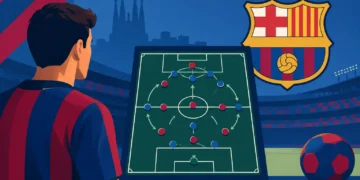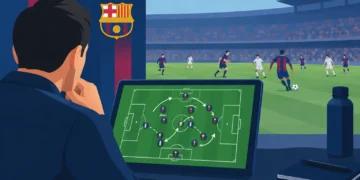

A teenager can look like a future superstar in a seven-minute highlight clip. He can beat three defenders, score from range, and collect millions of views before dinner. But that is not how Barcelona scout talent. At Barça, the question is rarely just whether a player has ability. The harder question is whether that ability can survive – and elevate – a game built on responsibility, space, and the ball.
That distinction explains why the club’s best recruitment stories have often looked obvious only in hindsight. Barcelona do not always need the biggest, fastest, or most physically imposing prospect in a youth tournament. They need players who see the next pass early, receive under pressure without panic, and understand that individual quality must serve a collective idea.
Barcelona Scout Talent With a Clear Football Idea
Every major club scouts with video, live reports, data, and a worldwide network of contacts. The difference is that Barça’s evaluation begins with a particularly demanding filter: can this player function in a positional game?
That does not mean every signing must be a miniature version of Xavi or Andrés Iniesta. Football changes, squads need different profiles, and modern Barça have had to add pace, power, one-v-one threat, and defensive athleticism. Still, the club’s identity creates non-negotiables. A midfielder must be comfortable receiving between lines with an opponent at his back. A fullback must understand when to support width and when to move inside. A forward has to recognize pressing triggers, protect possession, and attack space without disconnecting from the rest of the team.
For an outside observer, a player who records 20 goals or dominates a physical youth league can feel like an automatic target. For Barcelona, the tape needs a second viewing. What happens when he is pressed? Does he scan before receiving? Does he make teammates better when he is not scoring? Can he execute a simple action at the exact right speed?
Those details sound small. At the highest level, they decide whether talent becomes a first-team option or an expensive mismatch.
Technique is only the entry point
Barça’s historical standards make clean technique essential. First touch, short passing, body orientation, ball protection, and control in tight areas are all part of the basic examination. Yet technique alone does not separate a future Barcelona player from the thousands of gifted youngsters across Europe and beyond.
Decision-making is the separator. A winger may have the dribbling to beat his marker, but does he know when the move opens a passing lane and when it simply slows an attack? A center back may hit long diagonal passes, but can he resist forcing them when the better choice is to recycle possession? A striker may finish ruthlessly, but does he press with intelligence rather than charging alone?
The club is looking for players who can process the game at speed. That is why live scouting matters even in an era of endless footage. A scout can rewind a clip. A player cannot pause a match to choose his next action.
La Masia Is the Benchmark, Not Just a Pathway
When Barcelona evaluate external talent, they are not recruiting in a vacuum. They are comparing that player, directly or indirectly, with the academy options already developing at La Masia.
This is one of the most important realities behind any rumored operation. A 17-year-old central midfielder might be highly rated across Europe, but Barça must ask whether he is clearly ahead of the talent in the Juvenil ranks, Barça Atlètic, or the first-team training group. If the answer is no, the cost of a transfer can be more than a fee. It can block minutes, belief, and a pathway for a homegrown player who already understands the club’s football.
That does not mean Barcelona should avoid the market. The club has always benefited from identifying exceptional players beyond Catalonia, Spain, and even Europe. The best squads blend homegrown understanding with outside excellence. But the arrival has to raise the level decisively.
For supporters, this is why a flashy prospect rumor should be met with two questions: what is the player’s ceiling, and what problem does he solve that La Masia cannot already solve? Those are not anti-transfer questions. They are Barça questions.
The character report can change everything
Talent identification is also human identification. Especially with young players, scouts and recruitment staff need to understand how an individual responds to setbacks, coaching, competition, and attention.
A prospect entering Barcelona is entering more than a training program. He is entering a demanding club environment, a global spotlight, a dressing room full of expectation, and a fan base that knows the difference between a player wearing the shirt and a player understanding it. The adaptation can be difficult even for elite talents.
That is why references matter. Coaches, youth staff, former teammates, and people around a player can help build a picture beyond the match report. Is he receptive to tactical correction? Does he compete when the game turns against him? Can he handle being rotated? Is his support system stable enough for a major move?
None of that is glamorous. It can be the difference between a successful investment and another player who arrives with promise but never finds his place.
Data Helps Barcelona See What Highlights Hide
Modern scouting departments do not choose players with spreadsheets alone, but data is now central to narrowing the field and testing first impressions. For Barça, the most useful numbers are often tied to role and context rather than a simple goals-and-assists total.
A midfielder’s progressive passes, pressures, ball recoveries, and retention under pressure can reveal patterns that a short scouting package misses. For defenders, duel success, recovery actions, passing choices, and the ability to defend large spaces may matter as much as clean sheets. A wide attacker’s chance creation, carries into dangerous zones, and off-ball work can add crucial context to his end product.
Context remains everything. Numbers from a low-possession team will look different from numbers produced by a dominant side. A player thriving in transition may need a completely different evaluation from one asked to break down a deep block every week. Age, league strength, tactical instructions, and physical development all affect the picture.
That is why the smartest process combines evidence. Data identifies tendencies. Video explains them. Live scouting tests them. Conversations with coaches add the human layer. No single report should decide a Barcelona signing.
The Market Has Changed the Search
Barcelona’s financial reality has made recruitment discipline even more vital. The club cannot treat every emerging star as a must-have operation, nor can it assume a famous name is worth the full cost of the package. Transfer fee, wages, agent terms, registration conditions, and opportunity cost all belong in the discussion.
This has increased the value of scouting earlier. Identifying talent before the price explodes gives the sporting department more options. So does looking in markets where technical players may be undervalued, or where a contract situation creates leverage. But buying early carries its own risk: potential is not production, and development is rarely linear.
There is also a balance between scouting for the future and solving today’s needs. A 19-year-old may be the better long-term bet, while a 27-year-old could be the player who immediately fixes a weakness in a title race. The right choice depends on the squad, the coach’s system, the budget, and the academy pipeline. Supporters should be wary of any transfer debate that pretends one rule fits every situation.
Why the Best Scout Work Is Often Invisible
Fans usually see scouting through the final headline: agreement reached, medical completed, presentation scheduled. They do not see the months of monitoring, the repeated reports, the internal disagreements, or the decision to walk away.
Walking away can be as valuable as signing. A player may be excellent, but too expensive. He may fit one coach but not the club’s longer-term plan. He may be a strong prospect, but not stronger than the young player already waiting for his moment. Good recruitment is not collecting talent. It is building a squad in which profiles complement each other and the pathway remains credible.
That is the standard Barça should protect. The next great player may arrive from a distant academy, emerge from La Masia, or make the leap after years of patient development. Wherever he comes from, the badge demands more than a viral clip. It demands a footballer ready to think, fight, and play the Barcelona way.

Discover more from Barça Buzz
Subscribe to get the latest posts sent to your email.