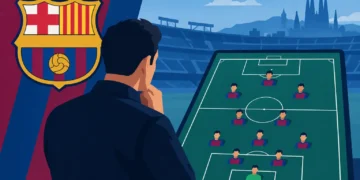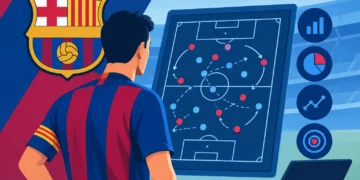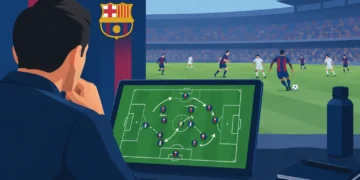
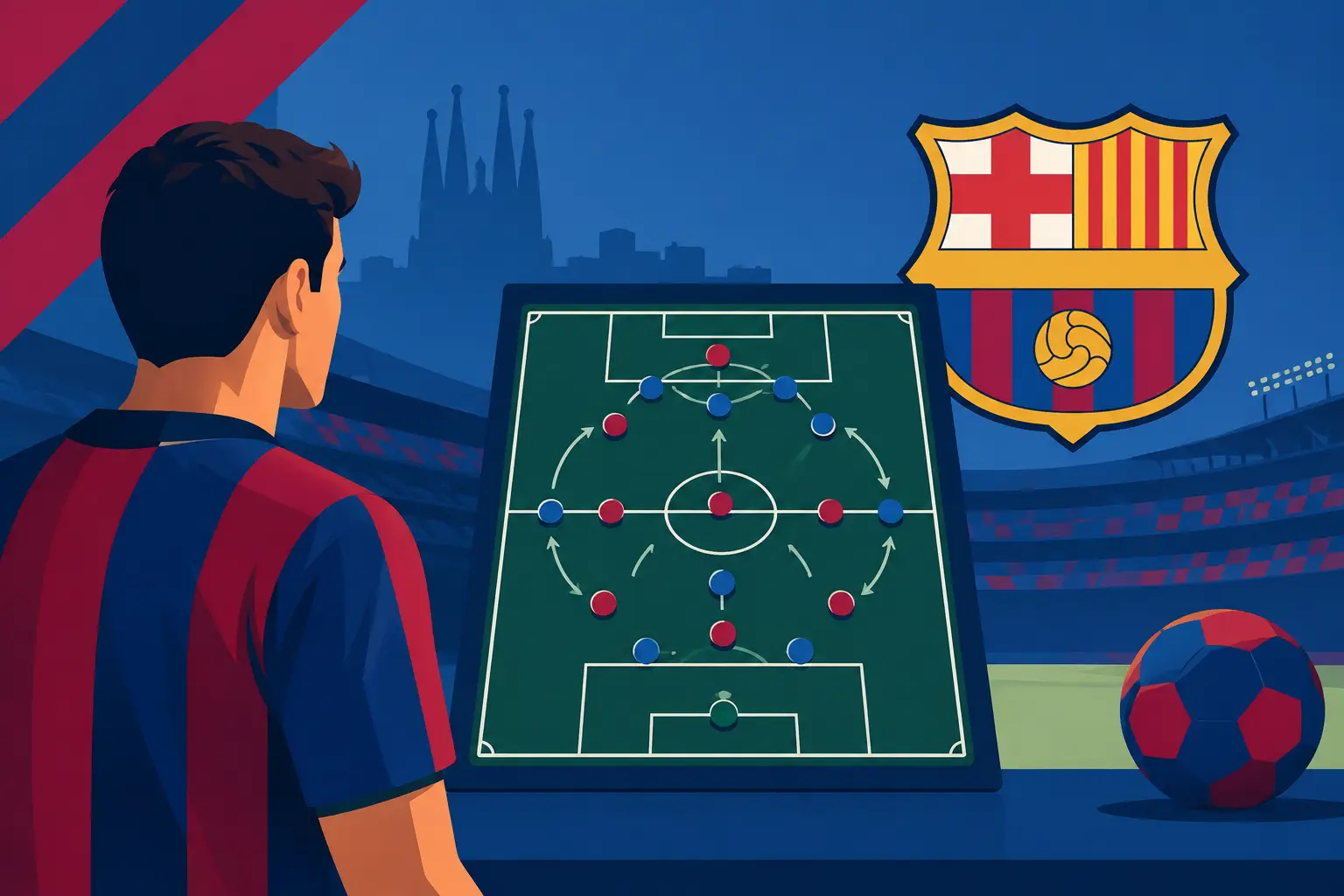
The numbers on a team sheet rarely tell the whole Barça story. A lineup can be announced as a 4-3-3, yet within minutes Barcelona may have a fullback stepping into midfield, a winger holding the touchline, and a center back carrying the ball into the next line. This Barcelona formation guide explains the shapes behind the label – and the principles that make a Barça side feel like Barça.
For supporters, understanding the formation is more than tactical trivia. It explains why a young midfielder may be asked to play patiently rather than chase goals, why wide players can look isolated, and why one injury can change the entire rhythm of a match. At Barcelona, shape is supposed to serve an idea: control the ball, create superiorities, and recover possession quickly when it is lost.
The Barça formation starts with 4-3-3
The classic Barcelona formation is the 4-3-3. It is tied to Johan Cruyff’s revolution, refined through generations of academy coaching, and associated with some of the club’s greatest teams. Four defenders, three midfielders, and three forwards sounds simple. The real purpose is to spread the pitch and give the player on the ball several clear passing options.
In possession, the goalkeeper and center backs begin the construction. The fullbacks provide width or move inward, the midfield creates triangles, and the front three stretch the opposition’s defensive line. The aim is not sterile possession for its own sake. It is to move opponents until a passing lane, a one-versus-one, or a runner between the lines appears.
The 4-3-3 also suits La Masia’s long-standing emphasis on technical security and spatial awareness. Players who have grown up in the system are taught to receive under pressure, scan before the ball arrives, and recognize where the next free man will be. That shared education is why Barça can integrate young talent more naturally than many elite clubs, even when the senior side’s personnel changes.
Still, the 4-3-3 is a starting point, not a sacred diagram. A coach may use it to attack one opponent and defend in a completely different shape.
What Barcelona’s midfield triangle is meant to do
At the heart of the system sits the pivot, traditionally the No. 6. This player links the defense to the attack, offers an outlet during the buildup, and protects the center when Barcelona lose the ball. Sergio Busquets remains the defining modern example: he did not dominate through speed, but through positioning, timing, and an elite understanding of pressure.
Ahead of the pivot, the two interiors connect different zones. One may drop toward the ball to help progress play. The other can arrive higher, combine near the box, or attack the half-space between the opposition’s fullback and center back. Xavi and Andrés Iniesta set a historic standard for those roles, although modern versions can be more physical, more vertical, or more goal-focused.
This is where formation talk can become misleading. If one interior pushes high and a fullback moves into midfield, Barça may look like a 3-2-5 in possession: three players forming the first line, two controlling the middle, and five occupying the attacking line. That shape is increasingly common across elite football because it places players across every important vertical channel.
The trade-off is obvious. Committing five players high can leave space behind them. If the rest defense is poorly organized, a single lost pass can turn into a dangerous counterattack. Barcelona’s best sides have limited that risk through immediate counterpressing, not by refusing to attack.
Why the wide players matter so much
A Barça winger is often judged by goals and assists, but their positioning can be just as decisive. When a winger stays wide, the opposing fullback has a difficult choice: follow them toward the touchline or tuck inside to protect the center. Either decision can open room for an interior, overlapping fullback, or striker.
On the opposite side, a winger may move inside to act almost like a second forward. That can create more bodies near goal, particularly against a low block, but it also makes the team narrower. In those moments, someone else must hold the width. If nobody does, Barcelona can end up circulating the ball in crowded central areas with little threat.
The central striker has a similarly flexible job. Some No. 9s pin center backs and finish moves in the penalty area. Others drop deep, pulling a defender with them and allowing wingers to run beyond. Neither profile is automatically better. It depends on the opponent, the available wide runners, and whether Barcelona need control or directness.
The Barcelona formation without the ball
Barcelona’s identity has always included aggressive pressure after losing possession. The first few seconds are vital. Rather than retreating immediately, nearby players try to close the ball carrier, block the obvious pass, and win the ball before the opponent can launch a transition.
Out of possession, a nominal 4-3-3 can become a 4-1-4-1, a 4-4-2, or another compact shape. The front line’s pressing angles matter more than the name of the formation. A striker may curve a run to force play toward one side, where the winger, fullback, and interior can close the trap.
Pressing high carries risk. If the first wave is bypassed, the pivot and center backs may be exposed across large spaces. That is why pace, anticipation, and tactical discipline in the back line matter so much. Against opponents with fast forwards or a strong long-ball game, Barcelona may press selectively instead of sending everyone forward at once.
When Barça shift to a double pivot
The 4-2-3-1 or 4-2-2-2 is not a betrayal of Barça principles. A double pivot can give the team more protection during transitions, help against an aggressive press, and free an advanced midfielder to operate closer to the forwards. It can be especially useful when the squad lacks a single natural holding midfielder capable of controlling every phase alone.
The cost is that Barcelona may lose one of the natural midfield connections that makes a 4-3-3 so fluid. Two deeper midfielders can become too flat, leaving a gap between the buildup and the attack. To avoid that, one pivot often needs to step forward at the right moment, while the attacking midfielder must remain available between the lines.
Supporters should also separate the formation from the personnel. Calling a setup a double pivot does not guarantee defensive stability, just as listing three midfielders does not guarantee control. Distances between players, the speed of circulation, and the willingness to counterpress decide far more.
How to read the shape during a match
Instead of staring at the pre-match graphic, watch three moments: Barcelona building from the goalkeeper, Barcelona attacking around the opponent’s box, and Barcelona reacting after losing the ball. Those phases reveal the real plan.
Ask who creates the first passing line, who occupies the width, and who protects against the counter. Then look for overloads. If Barcelona place three players around two opponents on one side, they may be trying to free a teammate on the far side. If a fullback repeatedly drifts inside, the winger is probably being asked to provide the sideline width alone.
The clearest sign of a functioning Barça structure is not endless possession. It is purposeful possession. The ball moves with enough speed to disorganize the opponent, players arrive in the right spaces before the pass is played, and a lost ball is treated as the first moment of defense.
Formation is a tool, not the identity
Barcelona will always be discussed through formations because the club’s football carries a tactical inheritance few teams can match. But the badge does not demand one frozen setup. Different coaches, opponents, injuries, and player profiles require different answers.
What should remain recognizable is the ambition to take responsibility with the ball, develop players capable of making smart decisions, and play with courage rather than fear. The next time the lineup says 4-3-3, watch what happens after kickoff. That is where the real Barcelona formation begins.

Discover more from Barça Buzz
Subscribe to get the latest posts sent to your email.