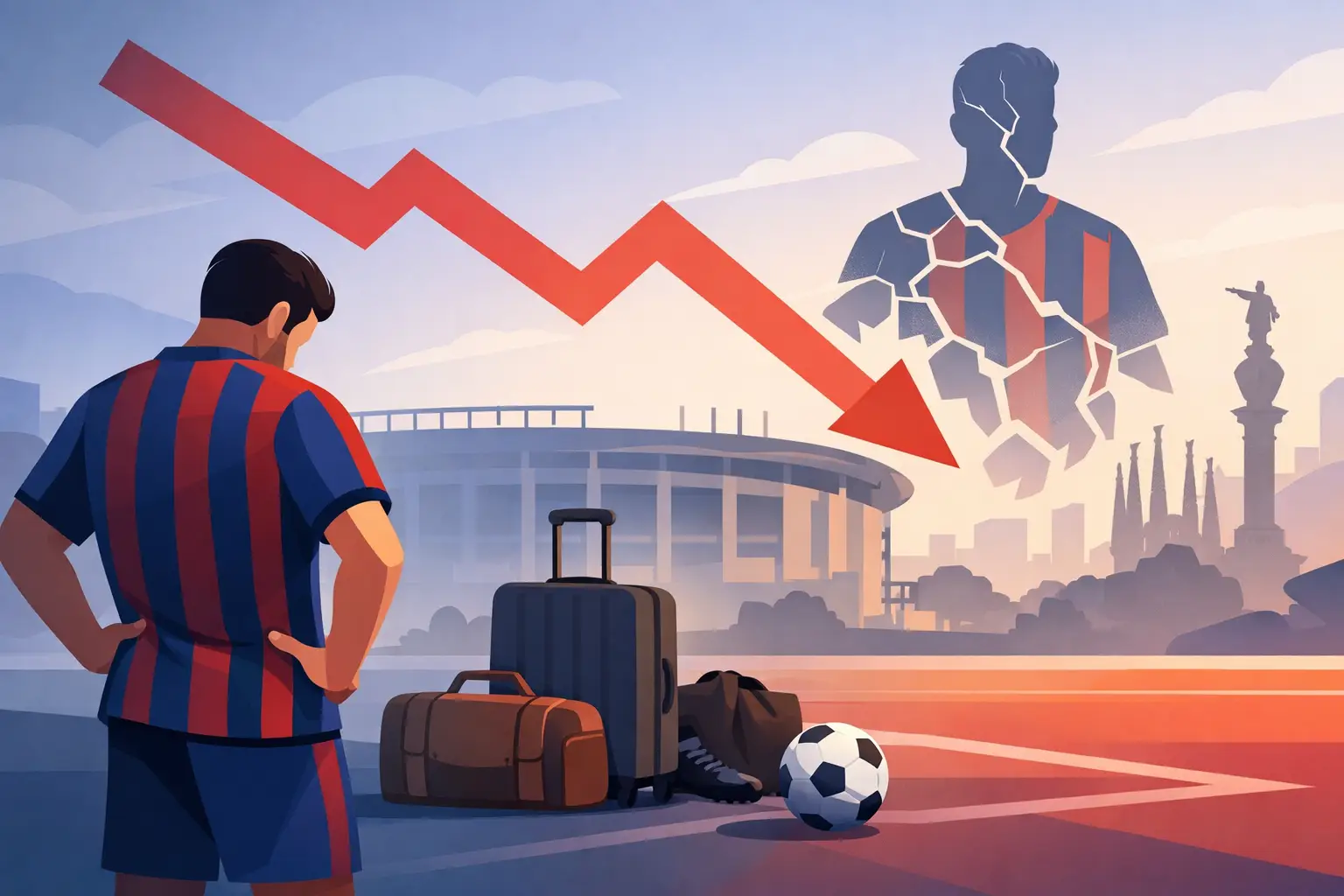
Philippe Coutinho arriving at Camp Nou for a record fee was meant to mark the next great chapter of Barcelona’s attack. Instead, one image came to define a painful era: Coutinho celebrating Bayern Munich’s 8-2 win over Barça while on loan at the German club. Barcelona transfer flops are not simply a collection of players who failed to score enough goals. They reveal how a club with a clear sporting identity lost its way in the market, spending enormous sums to chase star power while neglecting fit, structure, and timing.
For a club shaped by Cruyff, Pep Guardiola, La Masia, and the belief that the system should elevate the individual, that is what makes these deals sting. The issue was rarely talent. Most of these players arrived as elite names, often with genuine reasons for excitement. The problem was that Barcelona too often bought the reputation of a player rather than the role he would actually occupy.
Why Barcelona transfer flops hurt differently
Every major club has expensive disappointments. Barcelona’s carried a heavier cost because the club’s post-Neymar recruitment was tied to an unprecedented financial gamble. After Neymar joined Paris Saint-Germain in 2017, Barça had money to spend but also pressure to prove it could immediately replace one of the game’s most devastating forwards.
That pressure produced deals that looked understandable in isolation but chaotic as a collective plan. A left-sided creator arrived when Lionel Messi already dominated the central-right attacking zones. A winger with huge potential arrived with injury and professionalism questions. A world-class forward was signed even though his preferred spaces overlapped with Messi’s. The squad became more famous, not necessarily more coherent.
The fees also changed the standard by which every performance was judged. A player can need a season to adapt. A player costing well over €100 million is expected to transform the team at once, particularly at a club already wrestling with Champions League humiliation, boardroom instability, and the slow erosion of its wage structure.
Philippe Coutinho: the most expensive wrong fit
Coutinho remains the clearest example of a transfer that made emotional sense and tactical sense only from a distance. He had been brilliant at Liverpool, capable of carrying the ball, creating chances, and striking from range. Barcelona saw a player who could replace Neymar’s invention.
But Neymar was not merely an inventive attacker. He was a high-volume left winger who could beat defenders, stretch the field, and combine at speed with Messi and Luis Suárez. Coutinho preferred drifting inside onto his right foot, into areas where Barça already had traffic. Ernesto Valverde tried him as a left winger, an interior midfielder, and a No. 10, but none of those roles consistently brought out his best level.
The football was awkward, and the business became brutal. Barcelona paid a package widely reported to be worth up to €160 million, then watched Coutinho lose confidence and become a target for whistles. His loan spell at Bayern, including that infamous 8-2 night, made the situation feel almost surreal. He later helped Bayern win the Champions League, yet the move never truly worked because Barcelona did not have a stable role waiting for him.
Ousmane Dembélé: brilliant flashes, impossible frustration
Calling Dembélé a straightforward flop needs more care. At his best, the Frenchman was one of the most electrifying attackers Barça had after Neymar. He could go outside or inside, beat a fullback in either direction, and create unpredictability few players possessed. In the 2021-22 and 2022-23 seasons, he was a major attacking outlet under Xavi.
Still, the overall transfer cannot be separated from the fee, the injury record, and the lack of sustained return. Barcelona paid Borussia Dortmund an initial €105 million, with potential add-ons taking the total much higher. The expectation was not for occasional brilliance. It was for a franchise winger who would lead the post-MSN attack.
Repeated muscle injuries interrupted his rhythm, while questions around adaptation and discipline followed him in his early years. Some criticism became excessive, especially when he was recovering from physical problems rather than simply playing poorly. Yet the broader verdict remains disappointing: Barça spent a record-level sum and received too few defining seasons. Dembélé was not talent wasted by a lack of ability. He was a high-risk bet that never became the era-defining success the club required.
Antoine Griezmann: a superstar without a natural place
Griezmann’s case may be the most frustrating because his quality was never in doubt. He was a World Cup winner, an elite scorer, and a tireless presser at Atlético Madrid. Barcelona paid his €120 million release clause in 2019 and added one of Europe’s most intelligent forwards to its squad.
The question arrived immediately: where would he play? At Atlético, Griezmann had thrived with freedom to link midfield and attack, often operating off a striker and attacking central spaces. At Barcelona, Messi owned the right half-space and frequently dropped into the same creative zones. Suárez occupied the No. 9 role before his controversial departure, while the left side was often needed for a true winger.
Griezmann worked hard and produced respectable numbers, including a strong 2020-21 campaign. But respectable was not enough for a €120 million signing designed to help restore European dominance. His move exposed a recruitment habit that hurt Barcelona repeatedly: signing a great player because he was available, then trying to force the shape around him. His eventual return to Atlético was a financial necessity as much as a sporting admission.
The earlier warnings: Chygrynskiy, Song, and Gomes
The post-Neymar years were the costliest, but the warning signs arrived earlier. Dmytro Chygrynskiy joined Pep Guardiola in 2009 after impressing for Shakhtar Donetsk. Guardiola clearly admired his ability to play through pressure, but the defender struggled to settle and left after one season. It was a rare case of even Pep’s detailed vision not translating to the Camp Nou stage.
Alex Song and André Gomes represented different versions of the same issue. Song was a powerful, versatile midfielder at Arsenal but never looked fully suited to Barcelona’s positional demands. Gomes had technical quality and a strong reputation from Valencia, yet he appeared weighed down by the expectations around him. His later openness about anxiety during his Barcelona spell should also shape how supporters discuss the move. Not every failed transfer is a story of bad attitude or insufficient effort.
These were not the most expensive disasters, but they showed that Barça’s style is demanding in a specific way. A player needs more than technique. He must process space quickly, receive under pressure, understand the passing angles, and accept that the ball is a responsibility as much as a privilege.
What Barcelona learned, and what it still must avoid
The arrival of players such as Pedri, Gavi, Ronald Araújo, Jules Koundé, Raphinha, and Robert Lewandowski did not erase the mistakes, but it showed a more grounded approach could work. Some were expensive, and not every current signing will age perfectly. The difference is that the best operations have generally answered a clear squad need or fit a defined role.
The academy has also reasserted its value. Lamine Yamal, Alejandro Balde, Pau Cubarsí, Fermín López, and others have reminded the club that its greatest competitive advantage is not simply its global name. It is the pathway from La Masia to the first team. That does not mean Barcelona can stop signing established talent. It means every major investment has to complement the pathway rather than block it without justification.
Financial limits make that discipline non-negotiable. Barça cannot afford another sequence of signings made to calm a bad result, satisfy a presidential promise, or create a headline. The next great transfer should be measured against a simple standard: does he make Barcelona more Barcelona?
Supporters should demand ambition, because this club is built to compete for the biggest trophies. But the lesson from the expensive failures is equally clear. The right player is not always the biggest name, and a smart fit can matter far more than a summer-window statement.

Discover more from Barça Buzz
Subscribe to get the latest posts sent to your email.