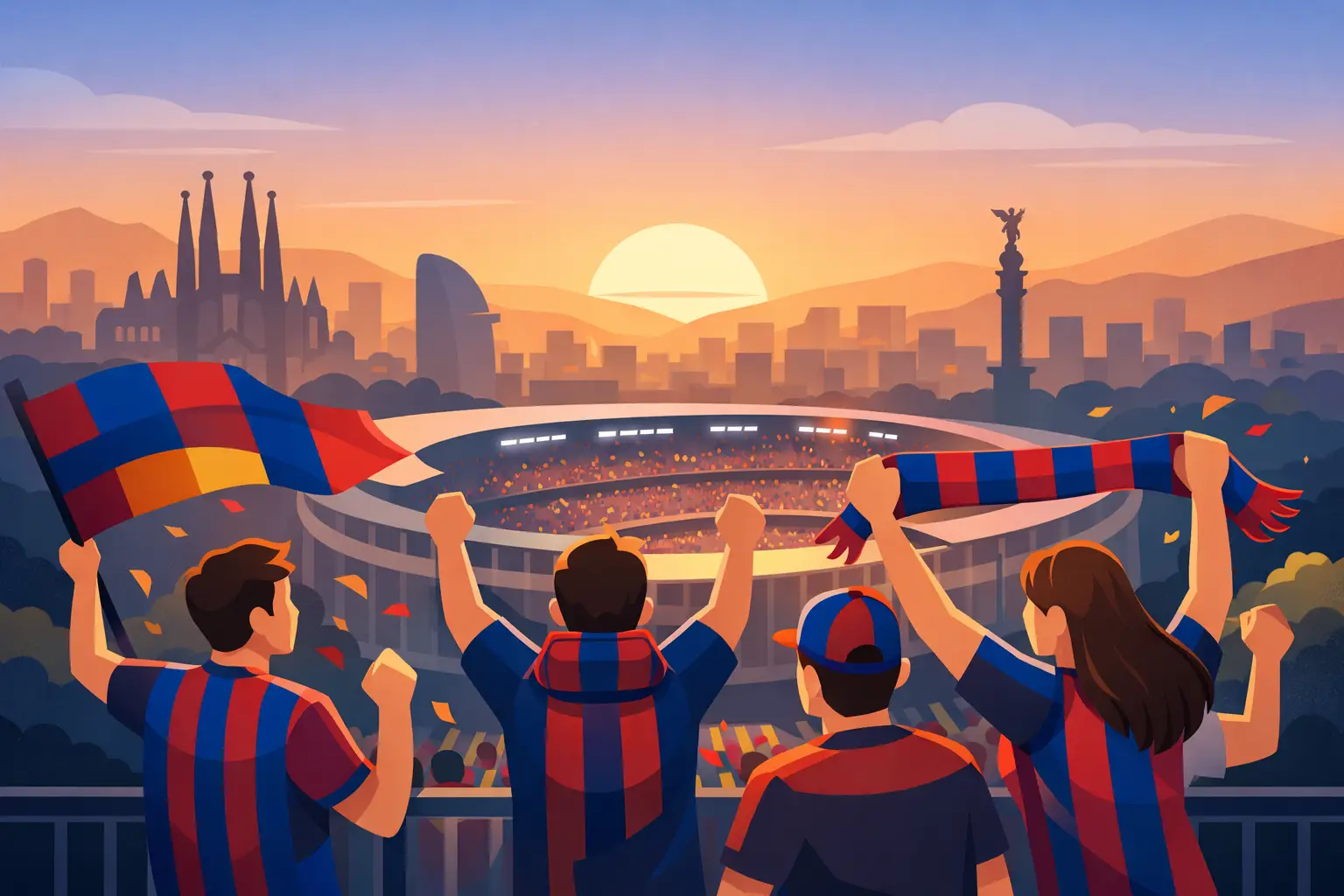
The question, “what does Visca Barca mean,” usually starts with a sound: thousands of voices rising at Montjuïc, a player shouting into a camera after a big win, or a message from a culé halfway around the world. It is short, loud, and unmistakably Barcelona. But it carries much more than a simple football celebration.
The phrase is Catalan, the language rooted in Barcelona and across Catalonia. Its closest English translation is “Long live Barça” or, more naturally in football terms, “Up Barça.” When supporters say or write “Visca Barça,” they are not just backing the team for the next 90 minutes. They are affirming an attachment to the club, its city, its history, and the identity that has made FC Barcelona different.
What does Visca Barça mean, exactly?
“Visca” comes from the Catalan verb viure, meaning “to live.” In this context, it is an expression of support or celebration, similar to “long live.” “Barça” is the familiar nickname for Futbol Club Barcelona.
So, word for word, Visca Barça means “Long live Barça.” In the stands, though, the feeling is closer to: “Come on, Barça,” “Força Barça,” or “May Barça thrive.” It is a declaration, not a tactical instruction. You say it after a Lamine Yamal moment of magic, after a tense Clásico win, or when the club needs its supporters most.
You will also see it written without the accent as “Visca Barca,” especially on English-language social media and in searches. The correct Catalan spelling is “Visca Barça.” The cedilla under the c gives the letter its soft “s” sound, which is why Barça is pronounced roughly “BAR-sa,” not “BAR-ka.”
How do you pronounce Visca Barça?
For English-speaking fans, a close pronunciation is “VEES-kah BAR-sah.” The first word is often said quickly, almost like “VEES-ka.” The emphasis falls naturally on the first syllable of Barça: BAR-sah.
You do not need perfect Catalan pronunciation to use the phrase with respect. What matters is understanding that it belongs to a living local language and a culture that remains central to the club. A global fan saying “Visca Barça” after a match is part of the modern Barça community. Knowing where the words come from makes that connection stronger.
Why Catalan matters at FC Barcelona
Barcelona is not simply a club that happens to be based in Catalonia. Catalan culture, language, and civic identity have shaped its story for more than a century. That is why phrases such as Visca Barça carry layers that a standard club slogan does not always have.
During periods when Catalan public expression was restricted, especially under Francisco Franco’s dictatorship, FC Barcelona became one of the places where collective identity could still be felt. The stadium was never separate from politics or society, even when football itself was the main event. Supporters gathered around the club because it represented more than results, trophies, or a league table.
That history is part of the meaning behind the famous line: “Més que un club,” or “More than a club.” The phrase can be used too casually now, particularly in marketing or online arguments. But at its core, it reflects the idea that Barça has long held cultural weight beyond sport.
Visca Barça is not automatically a political statement. Most fans use it as a straightforward expression of love for the team. Still, its Catalan language gives it a cultural context that should not be flattened into a generic chant. It means one thing in a caption after a Champions League night and another when it echoes through a stadium full of supporters who understand its historical resonance. Both are real.
Visca Barça vs. Força Barça
Newer supporters often hear both “Visca Barça” and “Força Barça,” and the phrases are closely connected without being identical.
“Força Barça” means “Come on, Barça” or “Strength to Barça.” It is more of an immediate rallying cry. You might hear it when the team is chasing a late equalizer, defending a narrow lead, or walking out before kickoff. It is direct encouragement aimed at the players.
“Visca Barça,” by contrast, has a more celebratory and enduring tone. It is about the club itself. A fan can say it after a title, after a painful defeat, on a former player’s farewell, or in a birthday message for the club. It does not depend on the scoreline.
The two often appear together, including in chants and fan posts: “Visca el Barça!” and “Força Barça!” There is no need to overthink the choice. If you are urging the side forward during a match, Força Barça fits perfectly. If you are expressing pride in the badge and everything around it, Visca Barça is the phrase.
The fuller chant: “Visca el Barça”
The most complete version is “Visca el Barça,” with “el” meaning “the.” That makes the literal translation “Long live the Barça.” In everyday usage, supporters often shorten it to “Visca Barça,” especially in conversation, on shirts, and online.
You may also encounter “Visca el Barça i visca Catalunya,” meaning “Long live Barça and long live Catalonia.” This version makes the club’s connection with Catalan identity explicit. Because Catalonia’s political status remains a sensitive and deeply contested subject, context matters here. Some supporters use the line as a natural expression of their identity; others prefer to keep their matchday support centered strictly on football.
The key point for international fans is simple: do not treat every Catalan phrase as a coded political message, but do not ignore its cultural significance either. Barça’s history is richer when viewed honestly, including the parts that cannot be reduced to transfer news or formation debates.
From Camp Nou to a global fan base
FC Barcelona now belongs to a truly global audience. A supporter in Miami, Manila, Lagos, or Los Angeles can follow every injury update, academy promotion, and contract negotiation in real time. Yet the club’s worldwide appeal has not erased its roots. If anything, its distinctive identity is one reason so many fans choose Barça in the first place.
Visca Barça travels well because it is easy to say, emotionally clear, and tied directly to the badge. It appears beneath highlight clips, in messages after Barça Femení victories, during Barça Basket celebrations, and in tributes to legends from Johan Cruyff and Xavi to Andrés Iniesta and Lionel Messi.
It also belongs to La Masia’s story. When a homegrown player breaks through, the reaction is rarely only about potential market value or squad depth. Supporters see a continuation of an idea: young players formed inside the club’s football culture stepping onto the biggest stage. That is why a first-team debut from a teenager can produce the same emotional language as a major signing. Visca Barça is for the entire ecosystem, not just the senior men’s side.
When should you use it?
Use “Visca Barça” whenever you want to show pride, solidarity, or joy around the club. It works after a win, before a huge match, in a comment celebrating a youth-team result, or when remembering a historic night. It is also fitting in difficult moments, when supporters want to make clear that their bond with Barça is bigger than a bad run of form.
There is one small practical point: use Barça, not Barca, when you can. “Barca” without the cedilla is widely understood, but it loses the correct Catalan spelling. The extra character is a small sign of care for the club’s language and heritage.
Football phrases often become empty when repeated without thought. Visca Barça has survived because its meaning remains alive: pride in the shirt, memory of the past, faith in the next generation, and the stubborn belief that Barcelona is never just another club. The next time the moment calls for it, say it with full voice: Visca Barça.

Discover more from Barça Buzz
Subscribe to get the latest posts sent to your email.