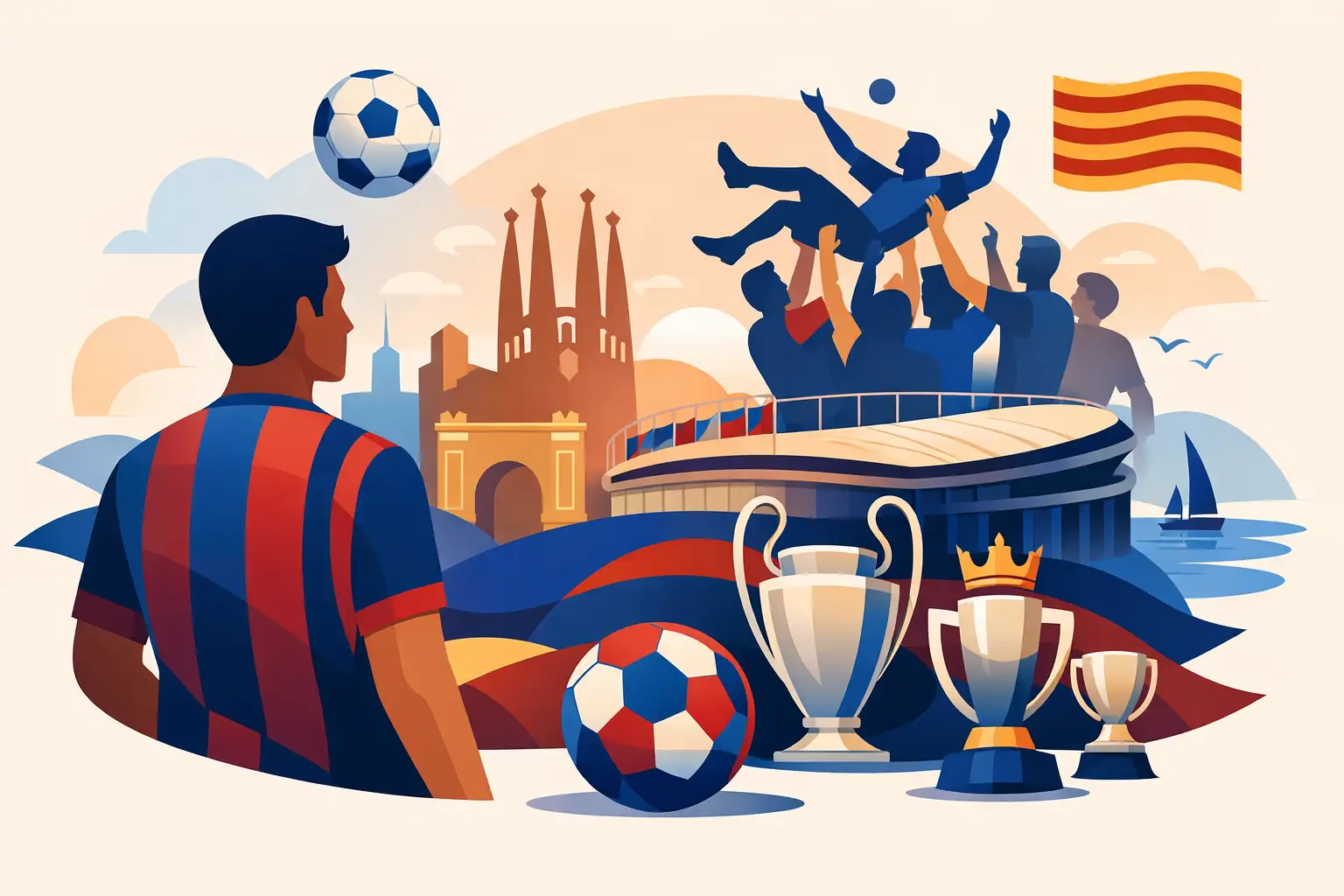
A Barça badge is never just a badge. It carries the red-and-blue stripes, the Catalan colors, the St. George cross, and more than a century of sporting ambition and social meaning. That is why FC Barcelona club history cannot be reduced to trophy totals, famous goals, or even Lionel Messi highlights. It is the story of a club that became a symbol of Catalan identity, built a footballing language recognized around the globe, and continues to wrestle with the cost of remaining itself.
A club born from an advertisement
FC Barcelona was founded on November 29, 1899, after Swiss sportsman Hans Gamper, later known in Catalonia as Joan Gamper, placed an advertisement seeking football players. The response produced a small multicultural group of enthusiasts, and Barça was born in a city where football was still establishing its place.
Gamper’s influence went far beyond founding the club. He served several spells as president, helped stabilize Barça during difficult financial periods, and pushed its growth from a modest side into a major Catalan institution. The club’s early homes, including the Camp del Carrer Indústria and Les Corts, gave supporters a physical center long before the Camp Nou existed.
Success arrived early, especially in regional competition. But the defining feature was already clear: Barcelona was becoming a meeting point for a distinct Catalan civic identity. The club’s later motto, Més que un club, was not invented as empty marketing. It reflected a relationship between institution, city, language, and supporters that had been forming for decades.
Why Barça became more than a football club
The political weight attached to Barcelona grew during the 20th century. Under the dictatorship of Miguel Primo de Rivera, Gamper faced pressure after supporters showed support for Catalan and British symbols during a 1925 match. The club was sanctioned, its stadium was closed temporarily, and Gamper was forced into exile. He died in 1930, but the episode became part of Barça’s collective memory.
The Spanish Civil War and Francisco Franco’s dictatorship brought far deeper trauma. Club president Josep Sunyol, a Catalan nationalist politician, was executed by Francoist forces in 1936. During the dictatorship, public expressions of Catalan culture were restricted, and Barça’s name and symbols were altered under political pressure.
Football did not become a simple act of resistance every weekend. The reality was more complicated. The club had to survive, compete, and operate within an authoritarian state. Yet for many Catalans, attending Barça matches offered one of the few large public spaces where collective identity could still be felt. That context explains why victories over Real Madrid carried emotions that went far beyond league points.
The Camp Nou era and the search for greatness
By the 1950s, Barça had outgrown Les Corts. The arrival of Hungarian superstar László Kubala accelerated the need for a larger stadium, and Camp Nou opened in 1957. It became the cathedral of the Barça world: a venue for historic European nights, political expression, title celebrations, and generations of supporters.
Still, the club did not dominate Europe immediately. Real Madrid set the early standard in the European Cup, while Barcelona’s brilliant teams often struggled to turn talent into lasting continental control. The 1970s changed the emotional temperature.
Johan Cruyff arrived as a player in 1973 and became an instant icon. His Barcelona team won LaLiga in 1974, including a stunning 5-0 win at the Santiago Bernabéu. Cruyff did not merely play beautifully. He represented possibility at a moment when Spain was approaching the end of the Franco era. Naming his son Jordi, a strongly Catalan name at the time, further strengthened his bond with the club and its people.
Cruyff’s playing spell was important. His later return as coach was transformational.
Johan Cruyff changed the club’s direction
Appointed manager in 1988, Cruyff brought ideas shaped by Ajax and Total Football, then made them unmistakably Barça. He wanted possession with purpose, defenders comfortable on the ball, wide players stretching the field, midfielders controlling space, and youth players trained to understand the same principles.
His Dream Team won four straight LaLiga titles from 1991 to 1994 and delivered the club’s first European Cup at Wembley in 1992. Ronald Koeman’s free-kick against Sampdoria is immortal, but the trophy mattered because it proved Barcelona could be European champions on its own terms.
Cruyff’s greatest legacy may be structural rather than sentimental. He reinforced the importance of La Masia, the academy residence and development system that had opened in 1979. Not every later coach copied his formations exactly, and they should not have. Football evolves. But the idea that Barça should develop intelligent, technical players and play proactively became a standard against which every era would be measured.
FC Barcelona club history reached its peak with Pep and Messi
The late 1990s and early 2000s brought major trophies, but also instability. Louis van Gaal’s teams won league titles and integrated academy talents such as Xavi Hernández, while the presidency of Joan Gaspart was marked by sporting decline and institutional frustration. Then came the revival under Frank Rijkaard.
Ronaldinho restored joy to the Camp Nou, Samuel Eto’o brought edge, and a young Messi began to look like a player from another footballing planet. Barcelona won the Champions League in Paris in 2006, but the true peak was still ahead.
Pep Guardiola took over in 2008 and produced one of the defining teams in football history. With Xavi, Andrés Iniesta, Sergio Busquets, Carles Puyol, Gerard Piqué, Dani Alves, and Messi at its center, Barça combined academy understanding with elite recruitment. The team pressed relentlessly, controlled the ball, and attacked with a precision that made elite opponents look ordinary.
The 2009 sextuple remains a unique achievement: LaLiga, Copa del Rey, Champions League, Spanish Super Cup, UEFA Super Cup, and Club World Cup in a single calendar year. The 2011 Champions League final against Manchester United at Wembley is often treated as the purest expression of Guardiola’s Barça. That judgment is fair, though it should not obscure the work, tactical discipline, and exceptional players behind the romance.
Messi ultimately became the club’s all-time leading scorer and its most decorated central figure. His partnership with Xavi and Iniesta made Barcelona feel inevitable at times. Later, under Luis Enrique, Messi joined Neymar and Luis Suárez to form MSN, powering another treble in 2015. Different style, same ruthless level.
The modern tension: identity, money, and renewal
Barça’s recent history has been less comfortable. The club has faced financial strain, high wages, expensive recruitment decisions, Champions League disappointments, and the painful departure of Messi in 2021. No honest history lesson should treat those issues as a temporary footnote. They have shaped squad construction, coaching decisions, transfer operations, and the atmosphere around every major renewal.
Yet the club’s ability to regenerate remains one of its most powerful traits. Gavi, Pedri, Alejandro Balde, Lamine Yamal, Pau Cubarsí, and other young talents have reminded supporters why La Masia still matters. Not every prospect becomes a first-team legend, and placing impossible expectations on teenagers helps nobody. But when academy players understand the shirt, the city, and the footballing principles from the start, they offer more than a short-term solution.
Barcelona’s identity also extends beyond the men’s first team. Barça Femení has become a global force, setting standards in both performance and support, while Barça Basket and the wider sporting sections preserve the multi-sport character that many modern superclubs lack. The club is enormous, but it is not one-dimensional.
For supporters following the next manager debate, the next contract renewal, or the next transfer rumor, history offers a useful filter. The biggest question is not simply whether a signing is famous or whether a coach has won elsewhere. It is whether the decision helps Barcelona compete now without cutting the thread that connects Gamper, Cruyff, La Masia, Camp Nou, and the generations still waiting to sing after the final whistle.

Discover more from Barça Buzz
Subscribe to get the latest posts sent to your email.