
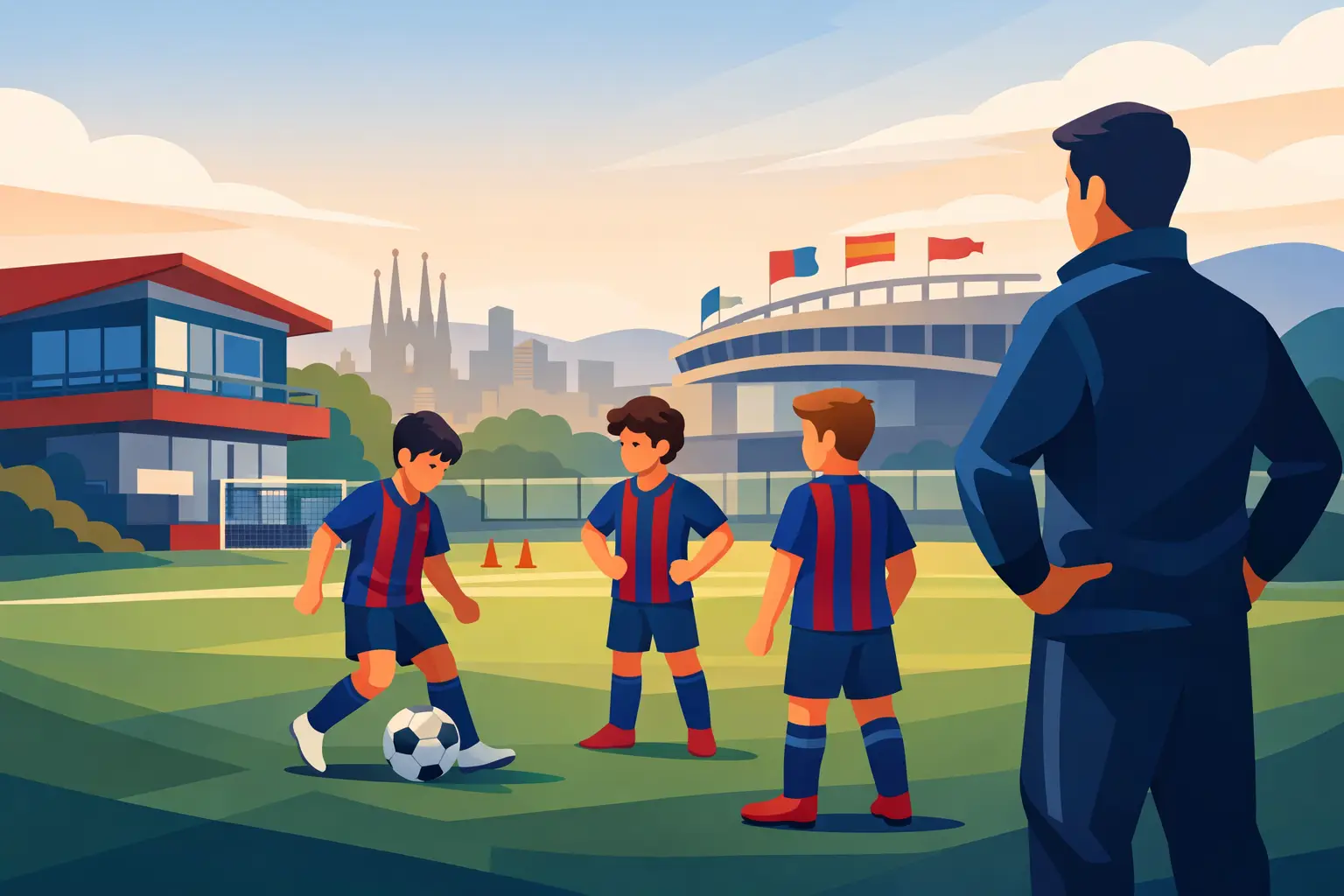
A teenager does not arrive at Barcelona and simply get handed a No. 10 shirt. The question of how does La Masia work starts with a harder reality: most talented young players will not reach the first team, and even fewer will become regulars. What makes Barça’s academy special is the effort to make the pathway feel connected from the youngest age groups to the senior squad.
La Masia is often spoken about as a building, a symbol, or a production line for legends. It is all three in a sense, but it is more accurately FC Barcelona’s youth-development system: scouting, coaching, education, housing for some players, sports science, and a football idea built around the club’s identity. It is designed to develop people as well as players – then give the best of them a genuine route toward the first team.
How Does La Masia Work From Recruitment to the First Team?
The process begins long before a player is close to senior football. Barcelona scouts extensively in Catalonia, across Spain, and internationally, looking for technical quality, game intelligence, character, and potential rather than just early physical dominance.
That last point matters. At youth level, the fastest or strongest player can look unstoppable. Barça traditionally puts greater value on a player who can receive under pressure, understand space, make the right decision quickly, and stay calm in tight areas. Size and speed still matter in modern football, especially as the game becomes more athletic, but they are not meant to be the whole evaluation.
Players enter different age groups depending on when they are identified. The academy structure runs through the club’s youth teams, from the youngest development stages through Cadet, Juvenil, and the reserve-team environment. Not every player lives at La Masia. The residence is primarily for young players who have moved away from home, while many locally based prospects continue living with their families.
For those who do reside there, the routine is demanding. School, training, recovery, meals, travel, and personal responsibilities all have to coexist. Barcelona’s academy has long stressed education because football careers are uncertain. A player can be released, suffer a serious injury, or simply see another prospect develop faster. The club’s responsibility is bigger than producing a midfielder for a future Champions League night.
The Barça Football Idea Is Taught Early
La Masia’s most recognizable feature is not a dormitory or a scouting network. It is the shared football language.
From an early age, players are taught to be comfortable with the ball and to understand positional relationships. The principles have evolved through different managers and sporting directors, but the recognizable foundations remain: building play from the back, creating numerical advantages, occupying spaces intelligently, pressing after losing possession, and using the ball as a way to control matches.
This does not mean every youth team copies the first team formation exactly. Nor should it. Coaches need room to adapt to the players available and the demands of the opposition. But the core concepts are repeated so often that a prospect promoted to an older group is not learning an entirely new sport.
A midfielder coming through the system is expected to scan before receiving, turn when the space is there, and circulate the ball when it is not. A fullback has to understand when to support wide and when to move inside. Center backs are asked to defend large spaces and initiate attacks, not merely clear danger. Forwards learn pressing triggers, combination play, and how to attack the box without blocking teammates’ lanes.
That continuity is why the best La Masia graduates can sometimes look unusually composed on debut. They are still young, and they can still make costly mistakes, but the principles are familiar. The tempo is what changes dramatically.
Development Is Not a Straight Line
The romantic version of La Masia suggests that every standout academy player moves naturally into the first team. The real pathway is far more ruthless.
As players progress, they face new tests: stronger opponents, less time on the ball, tactical adjustments, injuries, contract decisions, and competition from expensive senior signings. A brilliant Juvenil player may struggle in reserve football. Another prospect who was not the academy’s biggest name at 16 can mature late and suddenly look ready for LaLiga at 19.
This is where the reserve side becomes vital. Barça’s B team, often referred to as Barça Atlètic, gives elite prospects a bridge between youth football and the senior game. The results matter, but development matters too. A teenager needs minutes against adults, difficult away matches, physical duels, and tactical situations that cannot be recreated fully in academy fixtures.
Still, playing for the reserves does not guarantee a first-team opening. That depends on squad needs and timing. If Barcelona have an established starter, a high-profile signing, and an experienced backup in one position, a talented academy player may need patience, a loan, or a permanent move elsewhere. The club must balance two competing priorities: protecting a prospect’s development and building a squad capable of winning immediately.
For supporters, this is why calls to “just play the kids” can be both understandable and incomplete. La Masia should be central to Barça, but throwing a 17-year-old into a broken tactical setup or asking him to solve a senior team’s deepest problems is not always development. The right promotion has a plan behind it.
Why Some Graduates Break Through Faster
First-team readiness is more than talent. Coaches look at whether a player can execute instructions at senior intensity, cope mentally with pressure, and contribute without needing the whole team rebuilt around him.
A young player who understands the first team’s positional demands may earn opportunities quickly, especially if injuries open a door. Versatility can help too. A defender capable of playing centrally and at fullback, or a midfielder who can operate as a pivot or interior, gives a manager more reasons to trust him.
But there is a trade-off. Versatility should not become an excuse to deny a player a settled role. Some prospects need consistent minutes in their best position to show their real ceiling. Others benefit from learning multiple jobs before specializing. The answer depends on the player, the coach, and the state of the senior squad.
Contract management also shapes the pathway. Barcelona have to identify which prospects deserve long-term investment before other clubs make their move. In modern football, major European teams monitor La Masia closely. Keeping a talented player is not just about a salary. It is about offering a believable sporting path.
La Masia Is Bigger Than One Golden Generation
The academy’s history is inseparable from names like Xavi, Andrés Iniesta, Sergio Busquets, Gerard Piqué, Carles Puyol, and Lionel Messi. Those players set an almost impossible standard, particularly the generation that powered one of football’s greatest sides under Pep Guardiola.
Yet La Masia should not be judged only by whether it creates another Messi. That is an unfair test for any academy on earth. Its value is also in producing first-team contributors, intelligent professionals, players who strengthen the squad during financial pressure, and footballers who carry Barcelona’s culture into every level of the game.
The system has had difficult spells. Youth development can suffer when the first team changes coaches repeatedly, when recruitment blocks positions, or when academy teams chase results over learning. Barcelona also cannot rely on heritage alone. The club must keep improving scouting, individual coaching, physical preparation, and support for young players navigating intense public attention.
What should remain non-negotiable is the principle behind La Masia: a Barça player is developed with a view to the collective game, not simply individual highlights. When the pathway is functioning, a debutant does not feel like an emergency replacement. He looks like the next chapter of the club’s football memory.
That is the real promise of La Masia. Not that every prospect becomes a legend, but that every generation gives Barça a reason to believe its future can still be shaped from within.

Discover more from Barça Buzz
Subscribe to get the latest posts sent to your email.