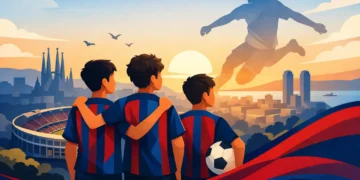
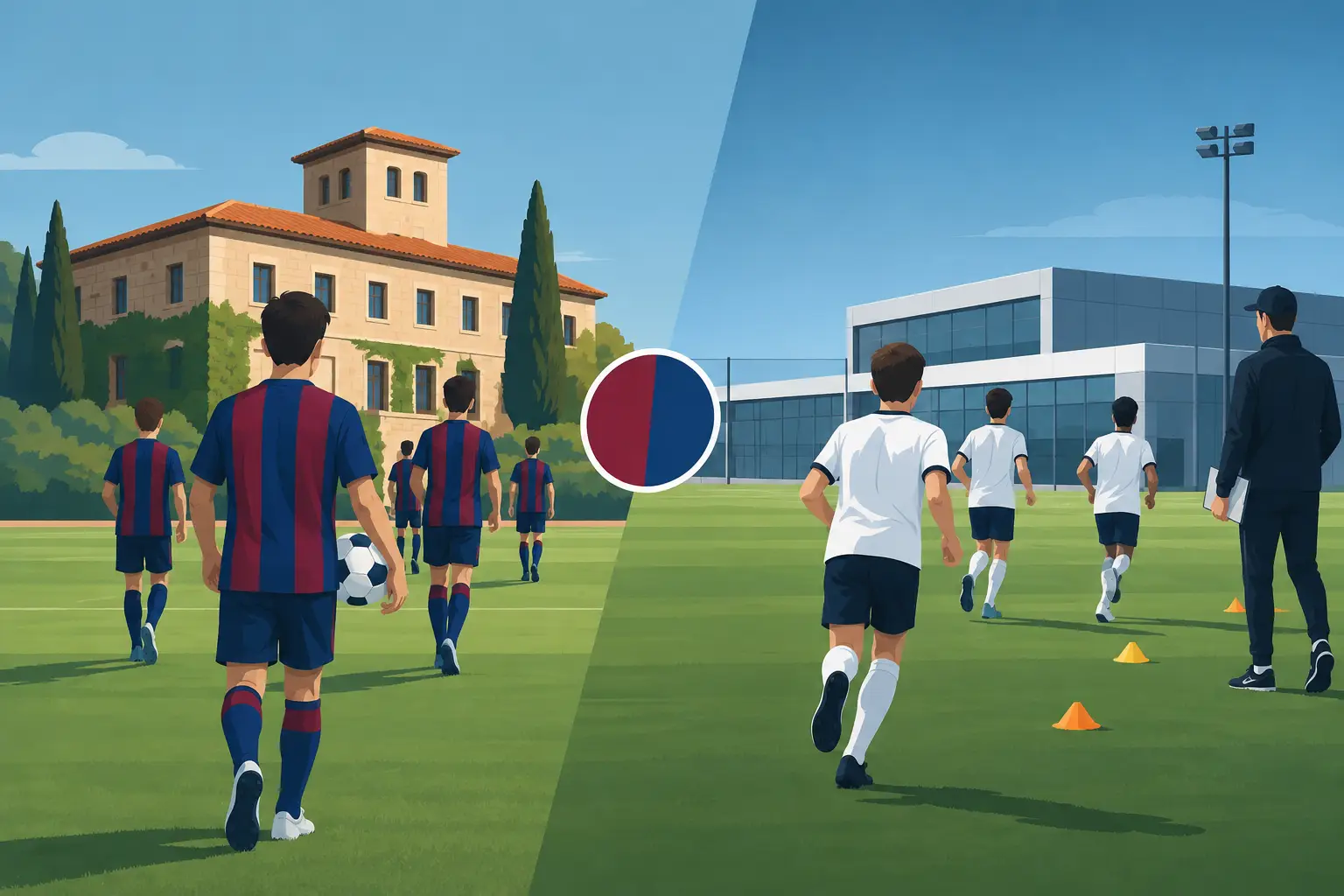
A 16-year-old Barça prospect does not reach the senior training ground carrying only a highlight reel. He arrives with years of positional habits, shared references, and an understanding of what the badge asks of him with and without the ball. That is the heart of La Masia versus academies: Barcelona’s famed pathway is not simply a factory for talented footballers. At its best, it is a system built to make first-team-ready Barça players.
That distinction matters whenever a teenager breaks through, a transfer fee rises into nine figures, or supporters ask why the club cannot just buy a solution. La Masia has never guaranteed greatness, and it has had lean stretches. But its greatest graduates reveal why it remains central to Barcelona’s sporting identity.
La Masia versus academies: more than a talent pipeline
Every major club wants an academy. Elite facilities, specialist coaches, data departments, nutrition plans, international recruitment, and carefully designed youth schedules are now standard at the top level. Manchester City, Chelsea, Real Madrid, Ajax, Sporting CP, Benfica, and Bayern Munich all invest heavily in producing players and protecting long-term value.
La Masia operates in that same modern environment, but Barcelona’s traditional ambition has been more demanding. The goal is not just to develop a player who can be sold, loaned, or fitted into a first-team squad. The goal is to develop a player who can recognize the club’s football language almost immediately.
That language has evolved across eras, but its core is familiar: control through possession, intelligent occupation of space, courage under pressure, coordinated pressing, and technical quality in tight areas. A young midfielder is not merely taught to complete passes. He learns where the next passing lane should appear, when to receive on the half-turn, and why a safe-looking ball can still damage the team’s structure.
For Barcelona, that shared education reduces the translation period that many expensive signings face. Xavi, Andrés Iniesta, Sergio Busquets, Lionel Messi, Gerard Piqué, and later Gavi, Alejandro Balde, Pau Cubarsí, and Lamine Yamal did not all become stars in the same way. Yet each entered the senior environment with a sense of the game that felt recognizable to Barça supporters.
The first team is the real classroom
The biggest difference is not the residence, the badge, or even the coaching curriculum. It is the credibility of the route ahead.
A youth player develops differently when he can look at the first team and see a genuine opening. At Barcelona, academy graduates have not been used only during ceremonial Copa del Rey nights or injury emergencies. In defining periods of club history, they have formed the spine of title-winning sides.
Pep Guardiola’s team offered the purest example. Messi, Xavi, Iniesta, Busquets, Piqué, Pedro, and Víctor Valdés gave Barcelona an internal core that understood the model at an extraordinary level. That group did not eliminate the need for major signings. Dani Alves, Samuel Eto’o, David Villa, and others were vital. But the academy spine gave the team continuity that money alone could not purchase.
The more recent generation has reinforced the point under different circumstances. Financial restrictions and squad turnover forced Barcelona to rely on youth sooner than planned, but opportunity still had to be earned. Gavi’s aggression, Balde’s athleticism, Cubarsí’s composure, and Yamal’s rare final-third ability mattered because they could contribute at senior level, not because they were symbolic choices.
This is where comparisons with other academies become complicated. A club can produce excellent players while offering limited minutes in its own first team. That is still development success. Chelsea’s academy, for example, has generated a remarkable volume of professionals, even when many established themselves elsewhere. Barcelona measures success more personally: can this player help Barça play, compete, and win?
A style that starts before the spotlight
La Masia’s reputation rests heavily on continuity. Youth teams are not expected to play like a collection of individual prospects trying to get noticed. They are expected to understand collective behavior.
That produces a recognizable type of player. Barça academy midfielders often appear unusually calm in crowded central areas because they have spent years being asked to solve pressure rather than avoid it. Defenders are expected to initiate attacks, not simply clear danger. Wide players must make decisions about width, interior movements, and pressing triggers. Even the goalkeeper’s role carries a footballing responsibility.
The benefit is obvious when the system is functioning. A young player can enter a first-team session without needing every concept translated from scratch. Coaches can focus on match-specific details, physical demands, and individual improvement rather than rebuild basic relationships with the ball.
There is also a risk. A strong identity can become rigid if coaches mistake repetition for learning. Modern football changes quickly, and Barça’s academy cannot live only on memories of the Guardiola era. Youngsters must be equipped to defend transitions, handle direct opponents, play through different pressing schemes, and adapt when the first team changes manager.
The best version of La Masia does not produce copies of Xavi or Messi. It gives each player a football education deep enough to express his own strengths within a shared idea.
Why money cannot simply replicate it
The commercial side of youth development is unavoidable. Top academies recruit earlier, scout more widely, and compete aggressively for the best teenagers. A club can build superb pitches, hire elite staff, and create a pathway presentation designed to impress families.
Barcelona can do all of that, but La Masia’s strongest asset is harder to manufacture: accumulated trust. Generations of players have shown young prospects that the first team can belong to them. The club’s history turns a distant dream into something concrete.
That trust also runs in the other direction. Supporters are often more patient with a young academy player who makes a mistake because they recognize what he represents. A La Masia graduate is not automatically protected from criticism, nor should he be. But there is an emotional connection that a new signing cannot instantly inherit.
For a club carrying financial pressure, the practical value is enormous. Academy players can reduce transfer spending, create squad depth, and preserve registration flexibility. They can also generate major sales when a pathway is blocked. Still, treating La Masia as a budget solution misses the point. If youth development becomes only an accounting strategy, standards fall and the pathway loses its meaning.
The romantic version has limits
Barça supporters should celebrate La Masia without pretending every answer is already in the Juvenil ranks. Elite football is unforgiving. Young players need the right timing, protection, and tactical fit. Throwing a teenager into a struggling side can damage confidence as easily as it creates a breakthrough.
Not every academy graduate has the physical profile, consistency, or ceiling to become a Barcelona regular. Some need loans. Some will build excellent careers elsewhere. Some will be overtaken by a signing who brings a quality the squad lacks. A balanced sporting plan needs academy promotion, smart recruitment, and clear development decisions working together.
The pressure to produce the next superstar can be especially unfair. Lamine Yamal is a generational case, not a benchmark every teenage winger should be judged against. For every teenage phenom, there are players whose progress depends on another season of growth, a tactical adjustment, or a less glamorous move away from the spotlight.
What Barcelona must protect next
The future of La Masia will not be secured by nostalgia. It will be secured by protecting coaching quality, maintaining a coherent football idea, and ensuring the jump from youth football to the senior game remains realistic.
That means Barcelona must resist both extremes. The club cannot close itself off from elite external talent when the squad needs it. Nor can it allow short-term transfer panic to block every promising pathway. The question should always be simple: does this decision make the first team stronger while preserving a credible route for the next qualified player?
For supporters, the joy is not only in saying a player came from La Masia. It is seeing him receive the ball under pressure at the Estadi Olímpic or Camp Nou, make the brave choice, and look like he has been preparing for that moment for years. When that happens, Barcelona’s academy is not a museum piece. It is the club’s future speaking in its own football language.

Discover more from Barça Buzz
Subscribe to get the latest posts sent to your email.