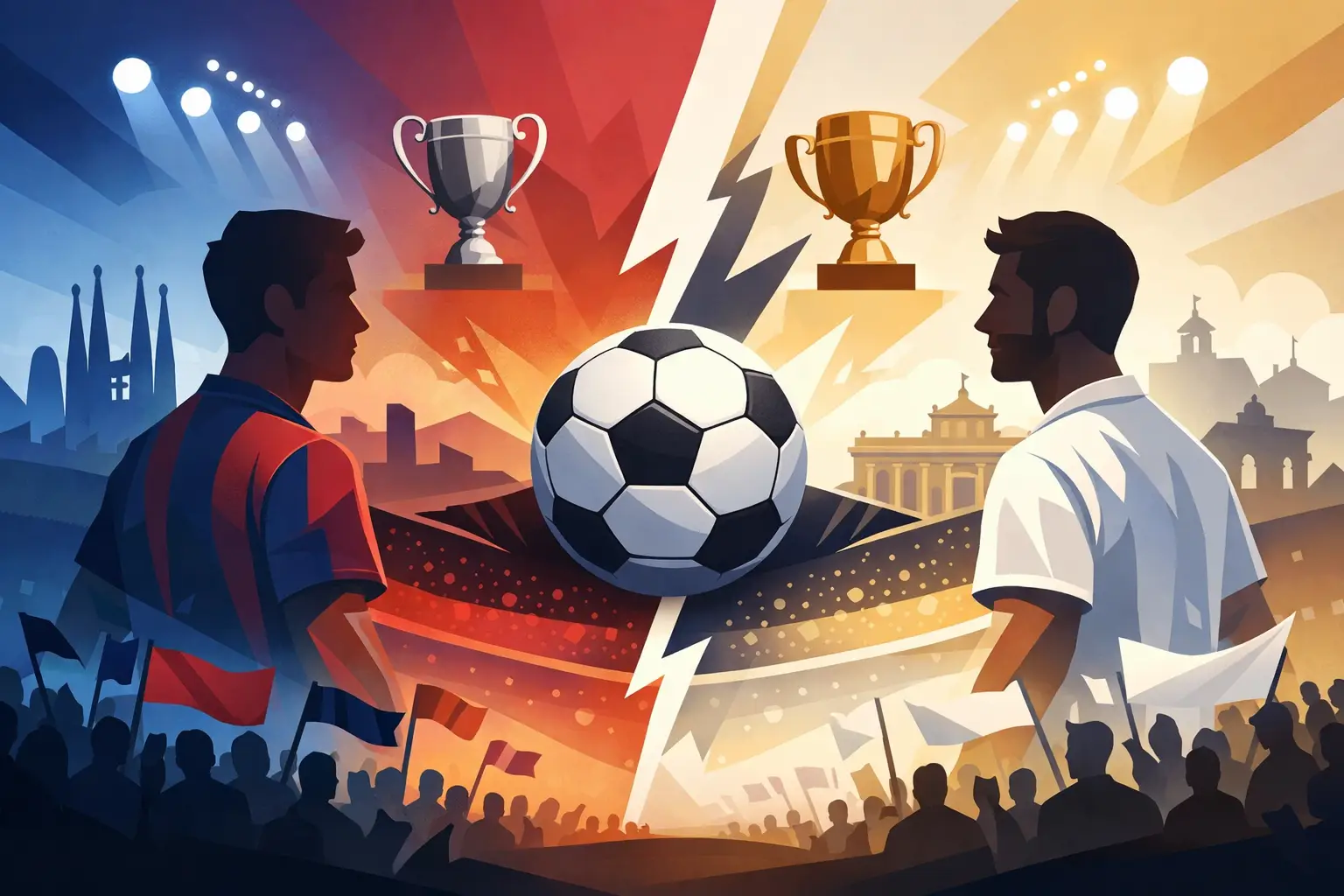
The whistle has not even blown, and the mood around Barcelona changes. Group chats fill up, old highlights return to the timeline, and every lineup decision suddenly feels like a referendum on the season. The Barcelona Real Madrid rivalry is not simply Spain’s biggest fixture. For Barça supporters, it is the match where footballing identity, club memory, and the demand to beat the opponent that matters most all collide.
A poor run can be forgiven with a statement performance in El Clásico. A strong season can feel incomplete after a painful defeat. That is the emotional weight Barcelona carry whenever Real Madrid are on the other side of the halfway line.
The Barcelona Real Madrid rivalry began with more than points
Barcelona and Real Madrid first met in 1902, long before LaLiga became the global television event it is now. Their sporting competition grew naturally, but the fixture acquired deeper cultural meaning as the two clubs came to represent distinct centers of power, identity, and ambition within Spain.
Barça’s connection to Catalonia is central to understanding that feeling. The club’s famous description, Més que un club, was never designed as an empty marketing line. Barcelona became a place where Catalan identity could be expressed, particularly during periods when cultural and political freedoms were restricted. Real Madrid, meanwhile, became associated by many with the capital and Spain’s central establishment.
That history deserves care rather than slogans. Real Madrid supporters come from every part of Spain and far beyond it, while Barcelona’s own support is global and diverse. It is too simplistic to treat every Clásico as a direct political battle. But it would be equally mistaken to strip the fixture of its historical context. The emotions attached to these clubs were built over generations, and they still shape the atmosphere around every meeting.
Different footballing ideas made El Clásico bigger
The rivalry became truly worldwide because it repeatedly placed elite teams with competing visions on the same pitch. Barcelona’s best eras have been defined by positional football, technical control, academy development, and the belief that how a team wins matters. Madrid have often paired world-class individual talent with transition threat, physical authority, and an unshakable relationship with European success.
Those descriptions are not permanent rules. Barça have had direct, pragmatic sides. Madrid have produced wonderfully intricate football. Yet the contrast remains powerful because supporters recognize the underlying argument. Is dominance about controlling the ball and the rhythm? Is it about finding the decisive action in the chaos? Can a team build greatness through a core raised at home, or through the relentless acquisition of the game’s biggest stars?
Johan Cruyff gave modern Barcelona a footballing language that still defines the club. His influence ran through the Dream Team, through La Masia, and eventually through Pep Guardiola’s historic side. Xavi, Andrés Iniesta, Sergio Busquets, Carles Puyol, and Lionel Messi did not just beat Real Madrid. They made Barça’s idea of football impossible to ignore.
That is why a Clásico victory means more than three points. At its best, it feels like proof that Barcelona’s way can still win at the highest level.
The nights Barça fans never stop replaying
Some results become part of a supporter’s vocabulary. They need only a scoreline, a stadium, or a single piece of commentary to bring everything back.
The 5-0 win at Camp Nou in 1994, with Romário tormenting Madrid, announced the confidence of Cruyff’s Barcelona. The 2-6 victory at the Santiago Bernabéu in 2009 was even more defining. Guardiola’s side did not merely win a title-shaping match. It delivered one of the clearest demonstrations of positional superiority the fixture has ever seen, with Messi operating centrally and Barcelona pulling Madrid apart.
Then came the 5-0 in 2010. Xavi controlled the game, Iniesta found spaces no one else could see, and Barça’s passing reduced a star-studded Madrid side to chasing shadows. For many culers, it remains the purest expression of the Guardiola era.
Messi created his own chapter in the rivalry. His 2017 winner at the Bernabéu, followed by the iconic shirt celebration in front of the home crowd, became an image that traveled far beyond Barcelona. It captured the defiance, drama, and individual brilliance that make El Clásico football’s most charged club match.
But rivalry memory cuts both ways. Barça supporters also know the pain of heavy defeats, missed chances, and Madrid celebrations. That is part of what makes the great wins feel so valuable. This fixture does not allow either club to live only in its favorite memories.
From Messi versus Ronaldo to a new generation
For more than a decade, the Barcelona Real Madrid rivalry had an added layer: Messi versus Cristiano Ronaldo. Their numbers were absurd, their standards pushed each other higher, and every Clásico felt capable of producing a new individual masterpiece. It was a rare period when the sport’s two defining players met repeatedly in games that already carried enormous historical pressure.
Their departures changed the fixture, but they did not diminish it. The focus has shifted toward a new generation and toward the projects each club is trying to build. For Barça, that has meant watching La Masia talents take responsibility sooner than expected, alongside the pressure to recruit wisely and compete despite financial constraints. For Madrid, it has meant a transition toward younger stars while maintaining the expectation of immediate trophies.
That makes current Clásicos less predictable. A young Barcelona side can play with freedom and energy, but it may also be exposed by inexperience. A more established Madrid team can absorb difficult spells, yet it is not immune when Barça’s press, midfield rotations, and wide combinations click into place.
The stakes also depend on the moment. A league meeting in October is not identical to a title race showdown in spring. A Copa del Rey tie carries its own tension, especially across two legs. A Champions League meeting would feel different again because both clubs measure themselves against Europe as much as against each other.
Why El Clásico still matters to Barça now
Modern football has no shortage of manufactured noise. Transfer rumors, social media arguments, and tactical hot takes can make every week feel like a crisis. El Clásico cuts through that clutter because its importance does not need to be invented. Players understand it the moment they sign. Coaches know one result can alter public confidence. Academy graduates know exactly what it means to the supporters who watched them grow.
For Barça, the fixture is also a test of standards. Competing with Real Madrid requires more than emotion. It demands brave football, smart squad planning, physical intensity, and calm under pressure. Barcelona cannot beat Madrid simply by trying harder. The club has to be clear about its structure, protect itself in transition, and make its technical quality count in the final third.
Supporters should also resist turning every Clásico into a verdict on one player or one coach. A defeat can expose real flaws, especially if Barça are repeatedly losing midfield control or conceding the same transition chances. But a single match can hinge on fitness, refereeing decisions, a red card, or one extraordinary finish. The long-term project matters, even when the short-term pain is sharp.
The next Clásico will bring the same familiar nerves: the early team news, the tactical debates, the arguments over who should start, and the feeling that the season has suddenly narrowed to 90 minutes. For Barça fans, that is not a burden to escape. It is the privilege of supporting a club whose biggest match still asks for courage, quality, and a little bit of history.

Discover more from Barça Buzz
Subscribe to get the latest posts sent to your email.